
To improve an EPC rating from D to B, your home typically needs to gain around 13–26 SAP points, moving from band D at 55–68 points to band B at 81–91 points.
That usually takes a combination of upgrades such as insulation, heating improvements, better controls, glazing or solar. The right route depends on your current EPC score and the recommendations on your certificate.
For some older or harder-to-upgrade homes, reaching B may be costly, so it is important to focus on improvements that give the biggest realistic gain. For more context on the scoring system, see our guide to EPC rating meaning.
Understand Your EPC Gap Before Making Improvements
Before choosing upgrades, check your current EPC score. You can find an existing certificate through the GOV.UK EPC register. Your certificate shows both your current rating and a potential rating based on recommended improvements.
Band B starts at 81 points, so your starting position within band D matters. A home scoring 68 needs 13 more points, while one scoring 55 needs 26.
EPC band | SAP score | Gap to reach band B |
D | 55–68 | 13–26 points |
C | 69–80 | 1–12 points |
B | 81–91 | Target reached |
Your potential rating is useful for planning, but it is still an estimate. Understanding how EPC scores are calculated can help you see why some improvements have more impact than others.
Prepare Before Making EPC Improvements
Before spending money, review the recommendations on your current EPC. They show which improvements are expected to have the most impact on your property.
Keep an evidence pack for any work already completed or planned, including:
Insulation records and photos
Installation certificates and invoices
Exact boiler or heat pump details
MCS certificates for solar panels
If an assessor cannot verify an improvement, it may not be fully reflected in your new EPC. Keeping clear records helps avoid this problem.
You can also check EPCs for similar homes nearby and use an accredited domestic energy assessor who understands your property type.
Which Improvements Help Move EPC Rating From D to B?
Moving from D to B usually means combining several upgrades rather than relying on one change. Start with the measures recommended on your EPC and prioritise improvements that reduce heat loss or improve heating efficiency.
Upgrade | Typical cost | SAP impact | Disruption |
Loft insulation | £600–£750 | Medium | Low |
Cavity wall insulation | Around £2,200 | High | Low–Medium |
Suspended floor insulation | £1,400–£2,500 | Medium | Medium |
Modern boiler + controls | Around £3,900 | Medium–High | Medium |
Air source heat pump | Around £11,000 before support | Varies | High |
Double glazing | Varies by property | Medium | High |
Solar panels | Around £6,100 | Medium–High | Medium |
Heating controls | £370–£600 | Low–Medium | Low |
Costs are approximate and vary by property. See the Energy Saving Trust’s EPC improvement guidance for current advice.
1. Improve Insulation and Reduce Heat Loss
Start with the building itself. Loft, wall and floor insulation reduce heat loss and can make a significant difference to an inefficient home. Wall insulation can be particularly important where little or no insulation is currently present.
2. Upgrade Heating Systems and Controls
An old boiler can hold back your EPC score, while a modern boiler or suitable heat pump may improve overall performance. Heating controls, including thermostats and thermostatic radiator valves, can also help.
Heat pumps need careful assessment because their EPC effect can vary depending on the system and how it is recorded. Make sure your assessor has the exact make, model and installation evidence.
3. Improve Windows, Doors and Draught Proofing
Replacing single glazing with double glazing and dealing with draughts can reduce heat loss. However, glazing alone is unlikely to move most D-rated homes all the way to B, so it should normally form part of a wider plan.
4. Install Solar Panels and Renewable Energy
Solar panels can support a higher EPC rating by generating electricity at your property. Their suitability depends on roof space, orientation and shading.
If you are considering this route, see how much solar panels cost in the UK before comparing installer quotes.
5. Small Improvements That Support Your EPC Score
Lower-cost measures can add useful gains, especially when you are close to the next band. These include:
LED lighting
Thermostatic radiator valves
Hot water cylinder insulation
Better heating controls
Do not assume every smart device improves your EPC. Smart meters, energy-monitoring gadgets and similar products can help you understand or manage energy use, but they do not necessarily add EPC points. Focus first on the measures your certificate recommends.
Example EPC D to B Upgrade Paths
The best route from EPC D to B depends on your starting score, property age, construction and existing heating system. These examples are illustrative, as the actual EPC result must be confirmed by an assessor.
1930s Semi-Detached Home (D62 → B)
A 1930s semi may benefit from cavity wall insulation, improved loft insulation and a more efficient heating system. Adding suitable solar panels could provide the extra improvement needed to move towards band B.
Victorian Terrace Home (D58 → C/B)
Victorian terraces often have solid walls, making insulation more difficult and expensive. Heating improvements, loft insulation and solar may raise the score, but reaching band C can sometimes be a more practical target unless solid-wall insulation is suitable.
Modern Detached Home (D66 → B)
A modern detached home starting near the top of band D has a smaller gap to close. Targeted heating improvements, better controls, additional insulation or solar may be enough to reach band B.
Property type | Starting EPC | Possible improvements | Expected outcome |
1930s semi-detached | D62 | Cavity/loft insulation, heating, solar | Potential route to B |
Victorian terrace | D58 | Loft/solid-wall insulation, heating, solar | C or B depending on property |
Modern detached | D66 | Heating, controls, insulation, solar | Stronger potential for B |
How Much Does It Cost to Improve EPC Rating From D to B?
There is no fixed cost to move from EPC D to B. As a rough planning range, many homes may need £5,000–£15,000 of improvements, while older or harder-to-upgrade properties can cost more. Your starting score, insulation, heating system and property type all affect the final amount.
Budget | Possible improvements |
Under £1,000 | LEDs, draught proofing, TRVs, hot-water insulation |
£1,000–£5,000 | Cavity wall insulation, heating controls, selected heating or glazing upgrades |
£5,000+ | Solar panels, heat pumps, solid-wall insulation, major glazing work |
These are planning ranges rather than guaranteed costs. EPC points also do not translate directly into bill savings. Your actual payback depends on how much energy your household uses, your heating system and your tariff.
For comparison, see what an EPC rating C can mean for monthly energy costs.
Is EPC Rating B Always Worth Achieving?
EPC B can be worth aiming for if your home is already near the top of band D, the required upgrades are practical, or you plan to sell or remortgage and want a stronger energy rating.
It may be less sensible to chase band B when the cost becomes too high. Solid-wall homes, flats and properties with conservation restrictions can be harder to upgrade, and in some cases EPC C may be the more realistic target.
The best choice is the one that balances EPC improvement, upfront cost and the likely benefit to your home, rather than focusing on the letter grade alone.
Grants and Support Available for EPC Improvements
Several current schemes can reduce the upfront cost of improving your home, but eligibility depends on your property, income and location.
Support | What it can help with |
£7,500 towards eligible air-to-water or ground source heat pumps in England and Wales. Some eligible off-gas homes can receive £9,000 until 31 March 2027. | |
Insulation, heating and other efficiency improvements for eligible low-income or vulnerable households. ECO4 now runs until 31 December 2026. | |
Eligible households in England with EPC D–G homes may receive council-funded insulation, heat pumps, solar panels or smart controls. | |
Qualifying installed measures, including insulation, solar panels, heating controls and heat pumps, are currently zero-rated until 31 March 2027. |
Funding can change, so check the latest eligibility rules before arranging work. The Great British Insulation Scheme ended on 31 March 2026, although older guides may still mention it. Support also differs across England, Scotland, Wales and Northern Ireland, so check schemes available where you live.
Track Your Energy Improvements With EnergieBee
An EPC gives a useful estimate of how your home should perform, but it does not show what is happening day to day. Your actual energy use can be different depending on your heating habits, electricity use and any systems you have already installed.
That is where EnergieBee’s Energy page can help. It gives you a clearer view of how your home is performing over time, so you can track:
Electricity consumption
Daily and seasonal energy patterns
Solar generation
Changes in home efficiency after upgrades
This makes it easier to see whether the improvements you have made are actually reducing waste and helping your home perform better.
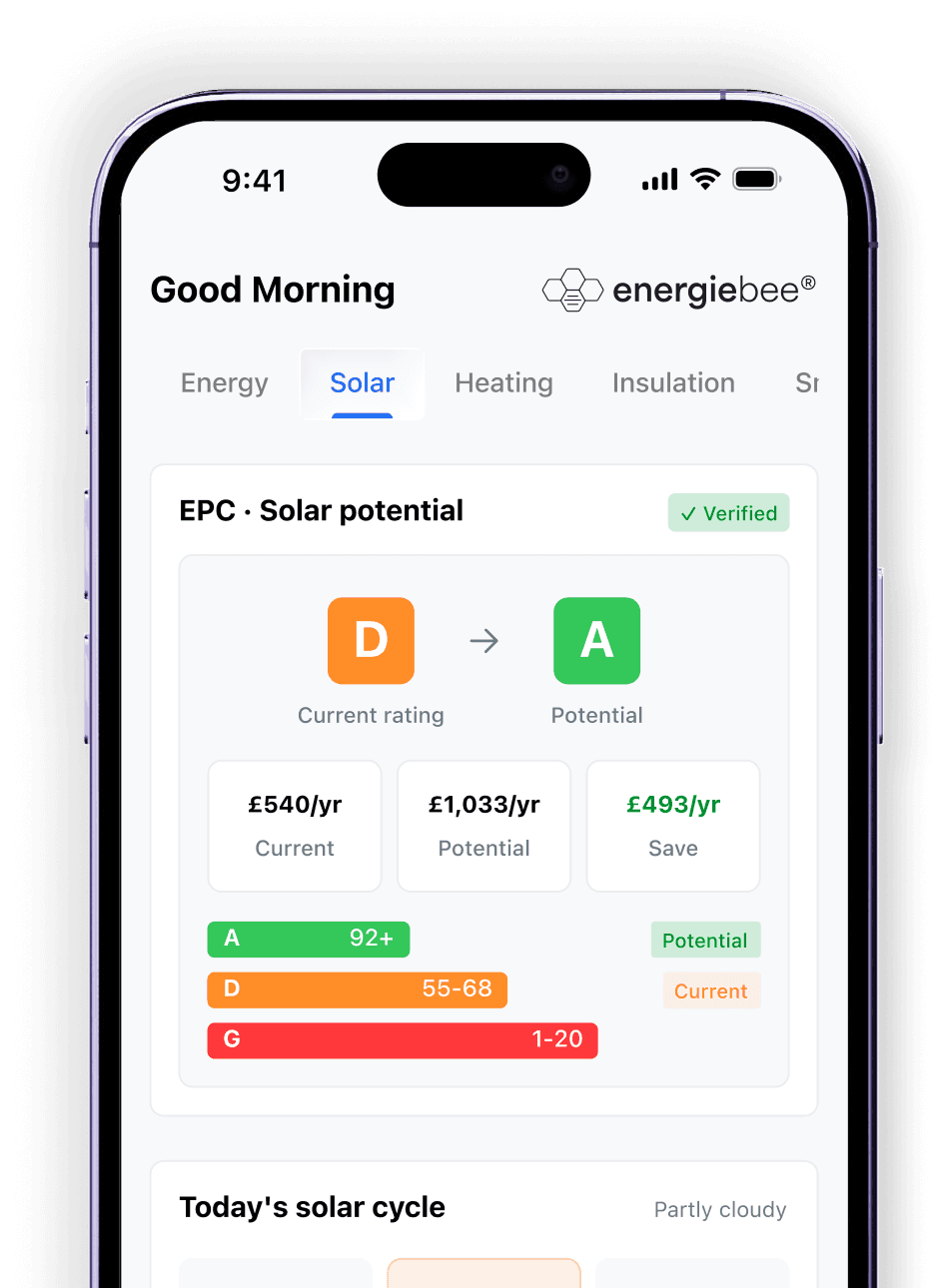
Take Control of Your Home Energy
EnergieBee turns complex energy data into clear, useful insights, helping you understand your home
Frequently Asked Questions
Can I improve my EPC rating without spending money?
Not usually by much. Changing everyday habits can reduce your energy bills, but EPC scores are mainly based on fixed features such as insulation, heating, windows and renewable systems. Low-cost improvements may help, but a significant jump from D to B normally requires investment.
Why did my EPC score go down after making improvements?
A lower score can happen if the new assessor records the property differently, cannot verify previous improvements, or uses updated information about your heating or insulation. Keep invoices, certificates, photos and exact product details so completed work can be properly assessed.
Can I improve EPC rating from D to B without solar panels?
Yes. Solar panels are not essential if insulation, heating and other improvements provide enough points to reach band B. Whether this is realistic depends on your starting score and the upgrade potential of your property.
Do smart meters improve your EPC rating?
A smart meter by itself does not normally increase your EPC rating. It can help you understand and manage energy use, but an EPC mainly scores the building's fixed energy features rather than how much energy your household actually consumes.