There is no single cheapest Economy 7 tariff for every home. Your best deal depends on your postcode, payment method, annual electricity use and how much falls within the cheaper off-peak hours.
As the Centre for Sustainable Energy explains, cheaper night rates come with higher daytime prices. Finding the best energy tariff for your home therefore means comparing the full cost, including standing charges. This guide explains how to compare suppliers, calculate your day and night costs, and check whether a single-rate tariff could be cheaper.
Which Supplier Has the Cheapest Economy 7 Tariff?
The cheapest Economy 7 supplier is the one offering the lowest total cost for your postcode and day/night usage split. A supplier with the lowest night rate can still cost more if its daytime rate or standing charge is higher.
Start with your current supplier’s renewal offer, then request comparable quotes from other providers. These official tools help you find tariff details; they are a shortlist for comparison, not a cheapest-to-most-expensive ranking.
Supplier | Where to check | What to confirm |
Tariff information and postcode quotes | The Economy 7 version, both unit rates and any exit fee | |
Tariff Information Labels | The exact tariff version and rates for your meter and region | |
Postcode-based tariff search | Day rate, night rate, standing charge and payment method | |
Tariff labels and personalised quotes | Eligibility and estimated costs based on your own consumption |
Use the same postcode, payment method, annual consumption and quote date for every comparison. Record the day rate, night rate, daily standing charge, contract length and exit fee. Include any required membership or bundled-service costs.
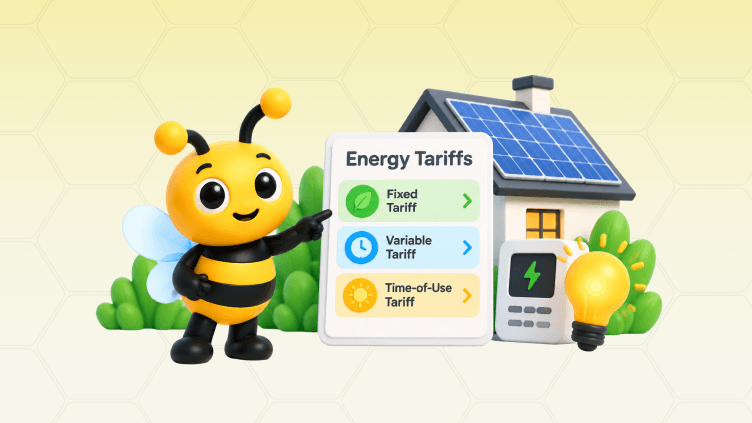
Compare fixed and variable offers separately: an annual estimate using today’s variable rates assumes those rates stay unchanged. Our energy tariffs explained guide covers how these pricing structures differ.
The worked example below shows why the cheapest option can change when your off-peak usage changes.
How Does Economy 7 Pricing Work?
Economy 7 charges a lower electricity rate during seven designated off-peak hours and a higher rate during the remaining hours. You also usually pay a daily standing charge. Gas is billed separately and does not receive an Economy 7 night rate.
Charge | What you pay for | Why it matters |
Day rate | Each kWh used outside the off-peak window | High daytime consumption can outweigh overnight savings |
Night rate | Each kWh used within the off-peak window | Savings depend on how much electricity you use during these hours |
Standing charge | A fixed amount for each day of supply | You pay it even on days when you use no electricity |
Storage heaters and hot-water cylinders can use electricity overnight and store heat for later. Direct electric heaters used mainly during the day may benefit less. Our guide to different home heating systems explains that distinction.
Economy 7 can have fixed or variable prices. For covered default tariffs in Great Britain, Ofgem’s price cap rules constrain tariff charges, but do not limit your total bill. Suppliers can use different day/night price combinations, so a national single-rate average is not your Economy 7 day-rate limit.
Is Economy 7 Cheaper Than a Single-Rate Tariff?
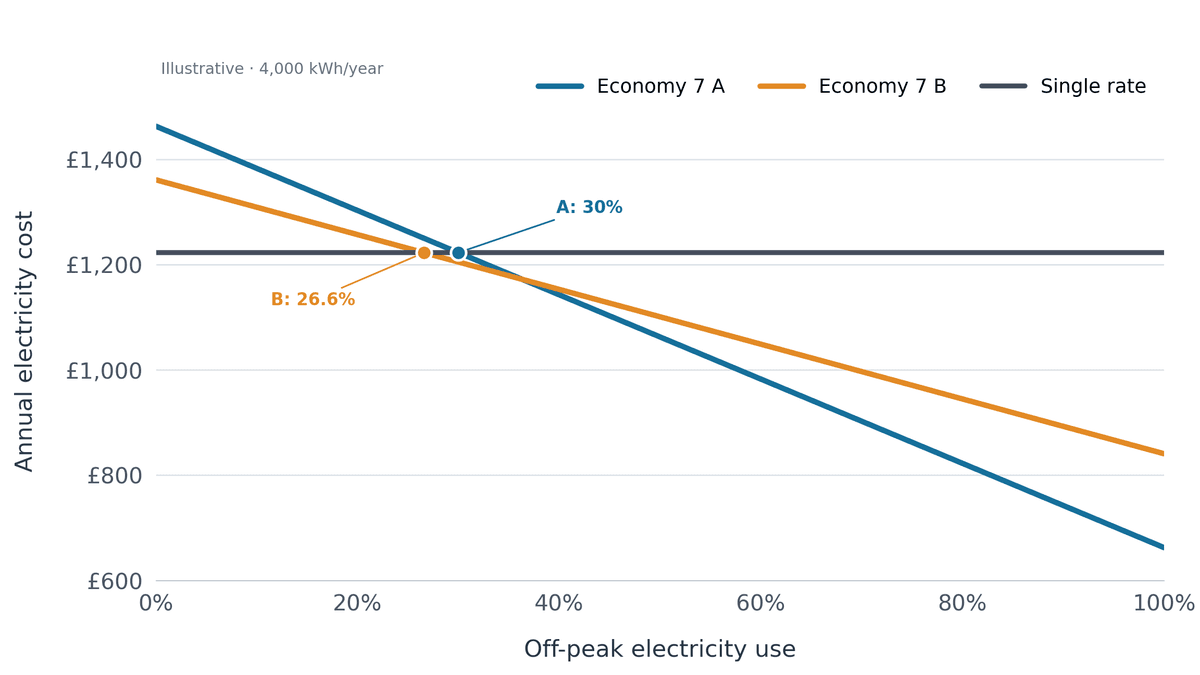
Economy 7 is cheaper when the savings during off-peak hours outweigh its higher daytime costs and any difference in standing charges. There is no universal percentage that guarantees a saving.
Compare both options using the same annual electricity consumption. As Ofgem explains how bills are calculated, unit rates and daily standing charges both contribute to the amount you pay.
How Much of Your Electricity Do You Use at Night?
Your off-peak percentage is the electricity used during your tariff’s cheaper hours divided by your total electricity use, multiplied by 100.
Off-peak percentage = off-peak kWh ÷ total kWh × 100
For example, 464 off-peak kWh out of 2,272 total kWh gives:
464 ÷ 2,272 × 100 = 20.4%
Use day and night consumption from the same period, ideally a full year. Storage-heating demand changes with the seasons, so one summer month can give a misleading picture.
Take consumption from your bills or subtract opening meter readings from closing readings for each register. Do not divide the meter’s lifetime totals or use your monthly Direct Debit amount.
If you have interval data, match it to the proposed tariff’s actual off-peak hours. EnergieBee’s electricity monitoring can help you understand your usage patterns; use supplier readings to establish the billed day/night split.
How Do You Calculate the Break-Even Point?
Calculate the annual cost of each tariff, including standing charges, then find the off-peak share at which the totals are equal.
Use rates in pounds in these formulas:
Economy 7 annual cost: day kWh × day rate + night kWh × night rate + 365 × daily standing charge.
Single-rate annual cost: total kWh × unit rate + 365 × daily standing charge.
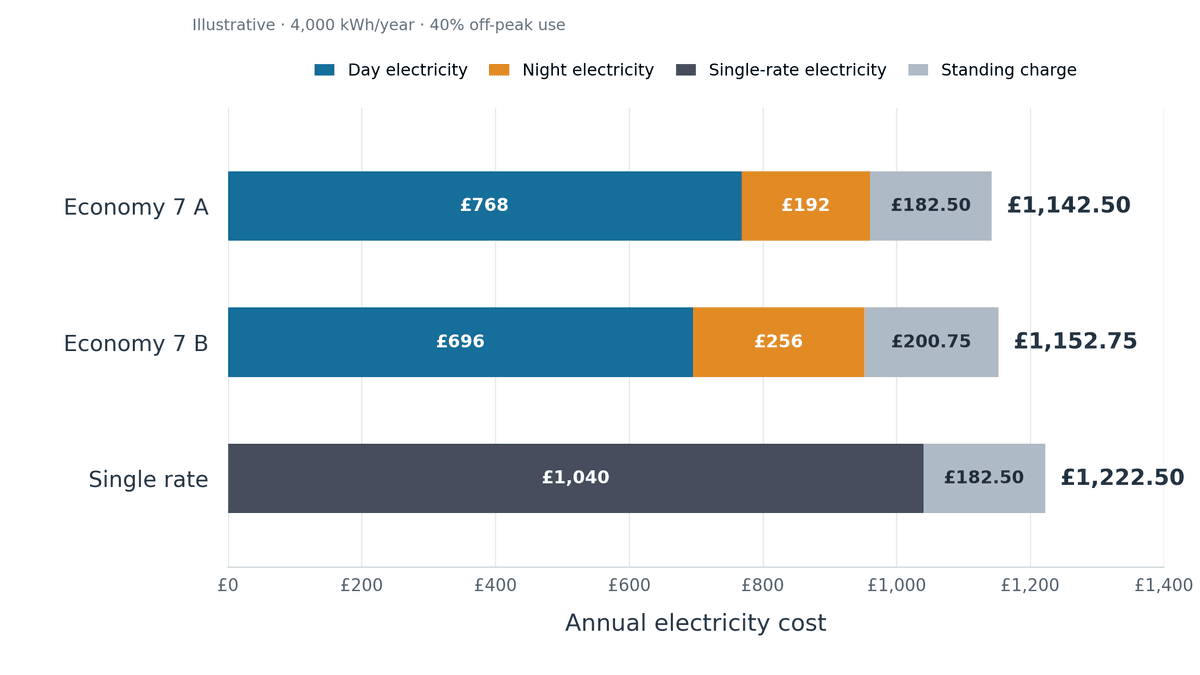
Here is an illustrative comparison using 4,000 kWh a year. These are invented teaching examples, not current supplier offers. Rates are treated as final consumer prices, unchanged for 365 days, with no exit fees, discounts or other charges.
Illustrative tariff | Day rate | Night rate | Daily standing charge |
Economy 7 A | 32p/kWh | 12p/kWh | 50p |
Economy 7 B | 29p/kWh | 16p/kWh | 55p |
Single rate | 26p/kWh | 26p/kWh | 50p |
Changing only the proportion used off-peak produces these annual costs:
Off-peak share | Economy 7 A | Economy 7 B | Single rate | Cheapest example |
20% | £1,302.50 | £1,256.75 | £1,222.50 | Single rate |
40% | £1,142.50 | £1,152.75 | £1,222.50 | Economy 7 A |
60% | £982.50 | £1,048.75 | £1,222.50 | Economy 7 A |
At 20% off-peak use, tariff A’s lower night rate does not make it the cheapest Economy 7 option. Tariff B costs £45.75 less, while the single-rate example is cheaper still.
Because tariff A and the single-rate example have identical standing charges, their break-even calculation is:
(32p − 26p) ÷ (32p − 12p) × 100 = 30%
Above 30% off-peak use, tariff A becomes cheaper in this example.
When standing charges differ, use the full formula:
Break-even off-peak share = [U × (D − S) + 365 × (C7 − C1)] ÷ [U × (D − N)]
Here, U is annual kWh; D and N are Economy 7 day and night rates; S is the single rate; and C7 and C1 are their daily standing charges. Use pounds throughout and multiply the result by 100 for a percentage. This assumes D is greater than N.
For tariff B, the break-even point is approximately 26.6%. That difference is why a blanket “40% at night” rule cannot replace a calculation using your actual quotes.
What Are Economy 7 Off-Peak Hours, and Do They Change in Summer?
Economy 7 hours depend on your supplier and meter configuration. Some schedules shift by an hour on your local clock during British Summer Time, so midnight to 7am is not a universal window.
For example, Octopus’s Economy 7 smart-meter guidance specifies 00:30–07:30 UTC. That appears as 00:30–07:30 in winter and 01:30–08:30 during British Summer Time. Other arrangements can differ.
Before setting heating or charging timers, confirm:
Exact hours: Ask for the schedule for your own meter, including any split periods.
Clock changes: Check whether the schedule follows UTC/GMT or local clock time.
Meter registers: Confirm which reading is day and which is night; do not assume “Rate 1” always means off-peak.
Heating controls: Check that storage-heater and hot-water charging periods match the cheaper window.
Recheck the schedule after switching supplier or replacing a meter. Reviewing controls is also a useful starting point when trying to save money on heating.
How Can You Find and Switch to a Cheaper Economy 7 Tariff?
Compare personalised annual costs using your actual day/night consumption, then check fees and meter compatibility before accepting a deal.
Gather 12 months of day and night consumption, your postcode, payment method and current tariff details.
Request quotes from your existing supplier and alternatives using identical assumptions.
Compare available Economy 7 and single-rate options, including standing charges.
Deduct applicable exit fees from the expected saving and check discount conditions.
Confirm the new off-peak hours and how your heating and hot water will be controlled.
Save the tariff terms and take both meter readings on the switching date if requested.
Check the VAT basis and effective date of each quote so you compare equivalent prices. Our tariff guides explain other pricing options you may encounter.
Citizens Advice’s switching guidance explains that fixed-tariff customers can switch without an early-exit fee during the final 49 days of their contract. Earlier switches may incur a fee. A new contract also normally has a 14-day cooling-off period; you still pay for energy already supplied.
Can You Switch to a Single-Rate Tariff Without Changing Your Meter?
Sometimes. A supplier may bill both registers at one rate or reconfigure a compatible smart meter, avoiding a physical replacement.
For example, EDF explains its single-rate options: it can change a smart meter’s Economy 7 mode or “totalise” readings from a traditional meter. Other suppliers may have different requirements.
Ask the new supplier to confirm compatibility before switching. If your meter controls separate heating or hot-water circuits, confirm how those circuits will operate afterwards and whether an electrician needs to check the setup.
Do You Need a Smart Meter or an RTS Meter Replacement?
A smart meter is not essential for every Economy 7 tariff, but your supplier must support your metering arrangement. Traditional two-rate meters can record day and night use; compatible smart meters can also support multi-rate billing.
RTS meters are a separate issue. They use radio teleswitch technology to control tariff periods and, in some homes, heating or hot water. Ofgem’s current RTS guidance says support has ended and advises remaining customers to contact their supplier for a replacement smart meter.
Ask the supplier to confirm the replacement’s tariff settings, off-peak hours and heating controls. Replacing RTS equipment does not, by itself, mean you must abandon Economy 7 pricing.
Understand Your Day and Night Electricity Use With EnergieBee
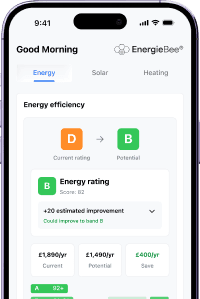
EnergieBee helps you see when your home uses electricity and how that usage affects your costs, giving you a clearer starting point for deciding whether Economy 7 fits your routine.
Before choosing a cheaper night rate, look at what your home actually does throughout the day. With EnergieBee, you can:
See your electricity use: Follow consumption patterns and identify periods of higher demand.
Understand your spending: Review your electricity overview, including the contribution from standing charges.
Plan ahead: View projected monthly and annual electricity costs based on your consumption patterns.
Compare those patterns with your supplier’s confirmed off-peak hours. If much of your demand falls outside that window, consider which flexible uses could move before comparing tariff costs. The Energy Saving Trust recommends checking your past consumption and flexibility before choosing a time-of-use tariff.
Download EnergieBee, create your free account and follow the setup steps to connect your home. Start understanding your electricity use before your next tariff decision.
See When Your Home Uses Electricity
Spot your usage patterns and forecast costs before comparing tariffs.
See When Your Home Uses Electricity
See when your home uses electricity and forecast your costs. Download the free EnergieBee app.
Frequently Asked Questions
Can You Get Economy 7 Without Storage Heaters?
Yes. Storage heaters are not a requirement for Economy 7. You need a compatible meter and a supplier offering the tariff. Overnight EV charging, water heating or battery charging may provide enough off-peak demand to make it worthwhile. Compare your full annual cost before switching; simply having a two-rate meter does not guarantee savings.
Is Economy 7 Cheaper Than an EV or Storage-Heating Tariff?
Not necessarily. Specialist tariffs may offer cheaper charging periods or extra heating windows, but the best option depends on your whole-home consumption, daytime rates, standing charges and eligibility.
For example, Snug Octopus requires suitable storage heaters controlled through a compatible second-generation smart meter. For EV tariffs, check vehicle or charger requirements and whether discounts cover the whole home or only managed charging. Homes with several technologies should also consider how solar, batteries and heat pumps work together.
Can You Have Economy 7 Electricity and Gas With the Same Supplier?
Yes, provided the supplier offers a suitable Economy 7 electricity tariff and supplies gas to your property. Gas has its own unit rate and standing charge; the cheaper overnight electricity rate does not apply to it. Compare the combined annual cost against separate suppliers, as dual fuel is not automatically the best-value option.
What Is the Difference Between Economy 7 and Economy 10?
Economy 7 provides seven off-peak hours per day, usually overnight. Economy 10 provides ten, often split across overnight and daytime periods, as E.ON Next’s tariff guide explains. More cheap hours do not automatically mean a lower bill: compare all rates and confirm supplier availability, meter compatibility and heating controls.
Is Economy 7 Being Phased Out?
Economy 7 remains available; the retirement of RTS metering does not mean all Economy 7 tariffs are ending. Suppliers can support day/night pricing through compatible smart meters. If your supplier is replacing your meter or withdrawing a particular tariff, ask which off-peak options remain available and how your heating and hot water will operate.
How Do You Compare Economy 7 Tariffs in Northern Ireland?
Use the Consumer Council’s Economy 7 comparison table and request quotes using your own day/night consumption. Compare unit rates, standing charges, payment methods, discounts and exit fees. Check the table’s effective date and confirm eligibility with the supplier. Northern Ireland has a separate energy market, so Great Britain’s supplier rankings and Ofgem price cap do not apply.