
If your fixed energy tariff is coming to an end, don't rush to accept your supplier's renewal offer. You can fix it again, switch supplier or move onto a variable tariff. The best choice depends on the rates available and how much energy your home uses.
But timing matters too. Switch too early, and you could lose the cheaper rates you're currently enjoying. Wait too long, and you might end up on a more expensive tariff.
Here's what you need to know before your fix ends, so you can make the right choice for your home and your energy bills.
What to do when your fixed energy tariff is ending
First, check when your tariff ends. You'll find the date on your latest energy bill or in your supplier's online account. How soon your fix ends determines what you can do next.
If your fix ends in 49 days or less
Good news! You can switch to another energy supplier without paying an exit fee during the final 49 days of your fixed contract, as confirmed by Citizens Advice.
Start comparing deals now, but don't rush to switch. If your current rates are cheaper, ask your new supplier whether you can start the new tariff when your existing deal ends.
If your fix ends in more than 49 days
You can still look for better deals, but switching early might mean paying an exit fee.
Check how much your supplier would charge and whether the savings from a new deal would cover that cost.
Your fee-free switching period may also start earlier if your supplier has already sent your renewal notice, under Ofgem's switching rules.
How switching rules differ in Northern Ireland
The 49-day rule applies to England, Scotland and Wales, not Northern Ireland.
If you live in Northern Ireland, check your contract for notice periods and early cancellation fees. You can also use the Consumer Council's energy comparison tools to explore your options.
Ofgem’s energy price cap rose by 4% on 1 October, bringing the typical annual bill to £1,723. This affects capped variable tariffs, not existing fixed rates. Keep this in mind when comparing your next deal
What happens when my fixed rate energy tariff ends?
Your gas and electricity won't suddenly stop when your fixed tariff ends. But the rates you pay could change, depending on which tariff your supplier moves you to.
Here's what to expect.
What your supplier must send you
Before your fixed tariff ends, your energy supplier must send you a renewal notice explaining:
When your current tariff ends.
What tariff you'll move onto if you do nothing.
The new rates and charges you'll pay.
Your options for renewing or switching, including when you can leave without an exit fee.
Under Ofgem's rules, your supplier must give you enough notice to make an informed decision. There's no longer a requirement to send it exactly 42–49 days before expiry.
You might also receive an offer for another fixed deal. You don't have to accept it. Take a moment to compare the rates with other available tariffs before deciding.
What happens if you do nothing
In most cases, your supplier will automatically move you onto its standard variable tariff, also known as a default tariff.
Unlike your fixed deal, the prices can change over time. In Great Britain, most default tariffs are protected by Ofgem's energy price cap, which limits unit rates and standing charges, not your total bill.
Some suppliers may instead move you onto a qualifying fixed tariff without exit fees.
The good news? You're not stuck. Even if your old fix has already ended, you can still compare deals and switch to a more suitable tariff.
Just check your new rates first. You might be paying more than you did before, even if your energy usage hasn't changed.
Understand Your Home’s Energy Use before switching
Before choosing a new tariff, it helps to know when and how your home uses energy. That's where EnergieBee makes things easier.
Instead of checking multiple apps and bills, EnergieBee brings your heating, solar and household energy data into one dashboard.
You can:
Track your energy use and spot patterns that affect your bills.
Monitor solar generation and see how much electricity you use from the grid.
Compare energy tariffs based on rates and estimated annual costs.
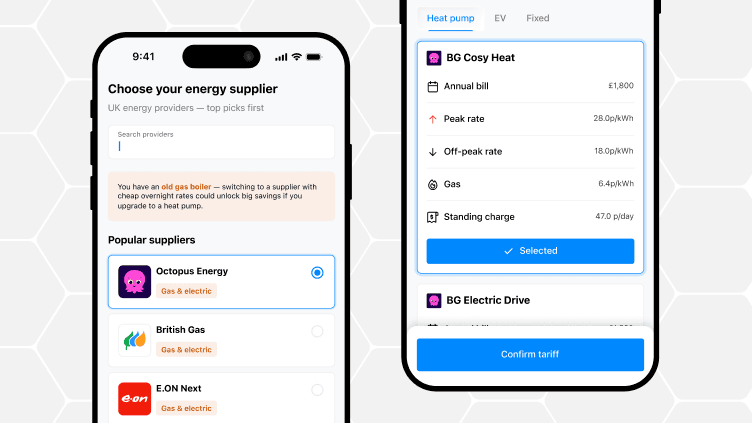
With a clearer picture of your energy use, you can choose a tariff that better suits your home.
Find a tariff that fits your home
EnergieBee brings your heating, solar and energy use into one dashboard, helping you understand your home's energy needs before choosing your next tariff.
What is the exit fee for a fixed tariff?
An exit fee is a charge your energy supplier may ask you to pay if you leave your fixed tariff before it ends.
There's no standard exit fee. The amount depends on your supplier and tariff, and you may be charged separately for gas and electricity. You can find the exact amount in your contract or tariff details.
However, you don't always have to pay it.
According to Citizens Advice, you can switch without an exit fee when your fixed contract has 49 days or less remaining. This rule applies in England, Scotland and Wales.
If you want to leave earlier, compare the exit fee with how much you could save by switching.
For example, if leaving costs £50 but a new deal would save you £100 over the same period, switching could still be worthwhile. Just check the full tariff costs before deciding.
Should I renew my fixed energy tariff?
Renewing your fixed tariff could be a good choice, but don't accept your supplier's offer without checking other deals first.
Your supplier might offer a convenient renewal, but that doesn't necessarily mean it's the cheapest option for your home. Here's what to consider before deciding.
Should I fix my energy tariff now?
If you want to protect yourself against possible energy price rises, fixing your tariff now could be worth considering.
A fixed tariff keeps your agreed unit rates and standing charges stable for a set period, usually 12, 18 or 24 months. That makes it easier to plan your energy spending.
However, if energy prices fall, you won't automatically benefit from the lower rates. You might also face an exit fee if you want to leave early.
The key is finding a competitive deal, rather than fixing at any price. If you're still unsure, our guide on whether you should fix energy prices now can help you weigh up your options.
How does my renewal offer compare with other deals?
Before accepting your renewal, check how it compares with offers from other suppliers.
Look at these four things:
Unit rates: How much you'll pay for each kWh of gas and electricity.
Standing charges: The daily amount you pay, even when you're not using energy.
Estimated annual cost: What the tariff would cost based on your home's actual energy usage.
Contract terms: How long the price is fixed and whether there are exit fees.
You can find your annual energy usage on your bill or in your supplier's account.
Don't compare deals based only on the monthly Direct Debit. Use the same annual energy usage for each quote to see which tariff could actually cost less.
Which is better: a fixed or variable energy rate?
It depends on whether you prefer predictable prices or more flexibility.
Fixed tariff | Standard variable tariff |
Unit rates usually stay the same for the contract period. | Rates can rise or fall over time. |
Helps protect against market price increases. | Usually follows Ofgem's quarterly price cap in Great Britain. |
May have early exit fees. | Normally has no exit fees. |
Won't automatically benefit if energy prices fall. | Can benefit when capped rates fall. |
If you're worried about prices rising, a competitive fixed deal might suit you better. But if you prefer the freedom to switch whenever a better deal appears, a standard variable tariff may be more suitable.
What if I use more energy on a fixed tariff?
Your bill can still increase, even when you're on a fixed tariff.
That's because a fixed tariff locks in the price per unit, not how much energy you use.
For example, if you start heating your home for longer during winter or charge an electric car more often, you'll use more electricity or gas. So your bill will increase, even though your unit rates haven't changed.
Your supplier may also adjust your monthly Direct Debit if your estimated annual usage changes.
Are energy prices going up or down?
Right now, energy prices are rising in Great Britain, and forecasts suggest another increase could be coming in January 2027.
According to Ofgem, the energy price cap increased to £1,723 a year from 1 October to 31 December 2026, for a typical household using gas and electricity and paying by Direct Debit.
But that's not a limit on your total bill. Your actual costs depend on how much energy you use.
Looking ahead, forecasts vary:
Cornwall Insight predicted £1,999 a year for January 2027 in its 30 September forecast.
E.ON Next predicted £2,183 a year in its 26 October forecast.
These are predictions, not confirmed prices. Ofgem is due to announce the January 2027 price cap by 25 November 2026.
So, is it a good time to fix energy prices? Possibly. A competitive fixed deal could protect you if prices rise. But you should still compare the costs carefully, because forecasts can change and fixing isn't guaranteed to save money.
Should I switch Energy Supplier?
If your current supplier's renewal offer is more expensive than other available deals, switching could help you save money.
But you don't always need to change suppliers. Sometimes, your existing supplier may offer a competitive tariff.
Before switching, compare the total estimated annual costs, not just the monthly Direct Debit. Also check the contract terms and any exit fees.
Quick Checklist: Is Switching Worth It?
Before making your decision, ask yourself:
Is the new tariff actually cheaper? Compare unit rates, standing charges and estimated annual costs using the same energy usage.
Will I have to pay an exit fee? Check your current contract and whether switching early would still save you money.
Is the timing right? See if you can start your new tariff when your existing fix ends.
Does the tariff suit my home? Check off-peak rates, solar export payments and any special conditions if you have an EV, battery or heat pump.
Am I comfortable with the new contract? Look at its length, exit fees and the supplier's customer service.
If the new deal works out cheaper and suits your needs, switching could be worthwhile. Otherwise, renewing with your current supplier or staying on a variable tariff might make more sense.
How do I change Energy Supplier?
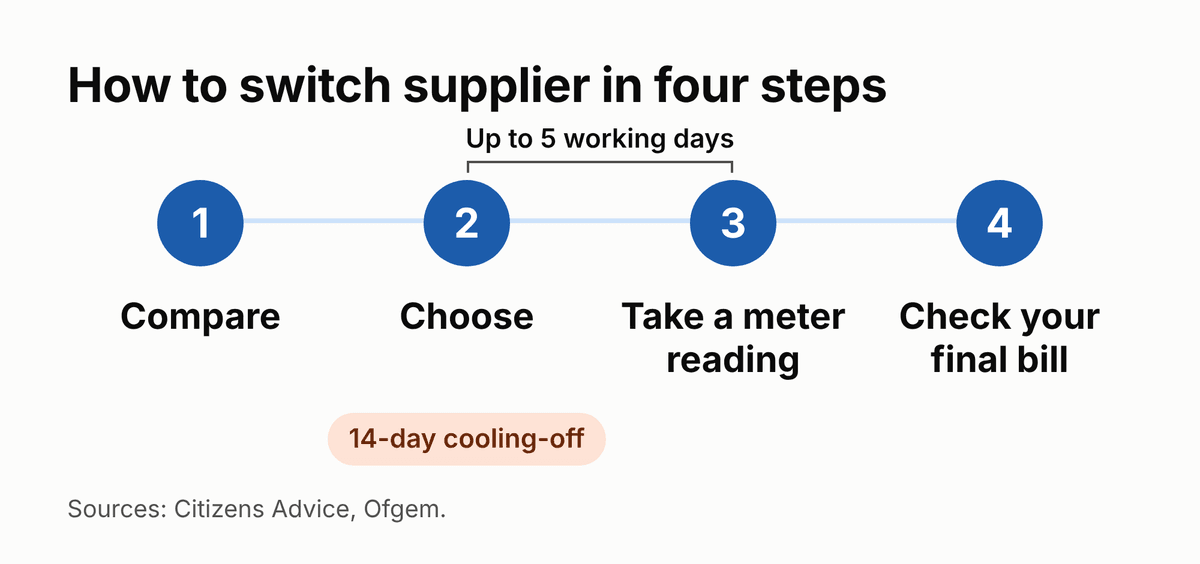
Switching energy suppliers is fairly simple. You don't need to contact your old supplier to cancel your contract. Your new supplier handles the switch for you.
Here's what to do:
Compare tariffs: Use your annual energy usage, current rates and postcode to find suitable deals.
Choose your new supplier: Sign up online or by phone and confirm when you want the new tariff to start.
Take a meter reading: Record your reading on the switching day so both suppliers can calculate your bills correctly.
Check your final bill: Your old supplier should send it within six weeks and refund any remaining credit.
You can find more details in Ofgem's energy switching guide.
How long does it take to switch Energy Supplier?
According to Ofgem, switching energy suppliers should take no more than five working days if you request the earliest available switch.
You'll also have a 14-day cooling-off period to cancel your new contract if you change your mind.
If your current fixed tariff hasn't ended yet, you can ask your new supplier to arrange a later switching date. This could help you keep your existing cheaper rates until your contract ends.
Can I switch Energy Supplier with debt?
Yes, you may still be able to switch even if you owe your current supplier money.
According to Citizens Advice:
Debt billed less than 28 days ago: You can usually switch.
Debt billed more than 28 days ago: Your supplier may block the switch until you repay it.
Prepayment meters: You may be able to switch with debts of up to £500 per fuel if your new supplier agrees to take on the debt.
There are exceptions, particularly if you're disputing an incorrect bill.
For more information, read our guide on switching energy suppliers with debt.
Fixed energy tariff ending: what to check for solar, batteries, EVs and heat pumps
If your home has solar panels, a battery, an EV or a heat pump, choosing the right tariff isn't just about finding the lowest electricity rate.
When you use electricity and how much you get paid for exporting it can make a big difference to your bills.
Before renewing or switching, check:
Solar panels: Check whether switching affects your export payments. You can use different suppliers for importing and exporting electricity, but some better export rates require you to stay with the same supplier.
Home batteries: Compare off-peak charging rates. You could save money by charging your battery when electricity is cheaper and using it during expensive hours.
Electric vehicles: Look for cheaper overnight charging rates, but check the daytime prices too. Some tariffs also require a compatible EV or charger.
Heat pumps: Check daytime electricity rates, as heat pumps often run throughout the day. A specialist tariff isn't always the cheapest option.
According to Energy Saving Trust, time-of-use tariffs can help you save money if you're able to shift enough electricity use to cheaper hours.
So, before choosing a new deal, compare what your whole home would cost to run, rather than focusing on one attractive tariff rate.
Fixed energy tariff FAQs
Are There Any Fixed Energy Deals?
Yes. Suppliers like British Gas, Octopus Energy and E.ON Next offer fixed tariffs. Compare current deals using your postcode and annual energy usage.
Will My Fixed Energy Tariff Increase?
Your agreed rates normally stay the same until your contract ends. However, your bill can increase if you use more energy or VAT changes.
Can I Choose When My New Tariff Starts?
Yes, you can request a specific switching date, but your new supplier may not guarantee it. Check with them before agreeing to the switch.
Will My Smart Meter Still Work If I Switch Supplier?
Usually, yes. However, some older smart meters may stop sending automatic readings after switching. Check compatibility with your new supplier before moving.
Can I Cancel My New Energy Tariff If I Change My Mind?
Yes. You normally have a 14-day cooling-off period after agreeing to a new energy contract. Contact your new supplier to cancel. You'll still need to pay for any energy you've used.
Will I Get My Account Credit Back If I Switch Supplier?
Yes. Your previous supplier must refund any remaining credit within 10 working days of issuing your final bill. The final bill should arrive within six weeks, according to Citizens Advice.

 Sharieaz Kavier


 David Price