
You can still switch energy supplier if you owe money, but it depends on how you pay for energy and when your unpaid bill was issued.
If you pay by Direct Debit or regular bill, debt billed at least 28 days ago may stop you from switching. With a prepayment meter, you may be able to switch with up to £500 of debt per fuel, provided your new supplier agrees to take it on.
This guide explains when you can switch, what happens to the money you owe, and what to do if your supplier blocks you.
How Can You Switch Energy Supplier If You Owe Money?
The rules for switching with energy debt depend on how you pay and when you were billed.
If you pay by Direct Debit or receive regular bills, the 28-day rule matters. For prepayment meters, it's the amount you owe for gas and electricity.
Your Situation at a Glance
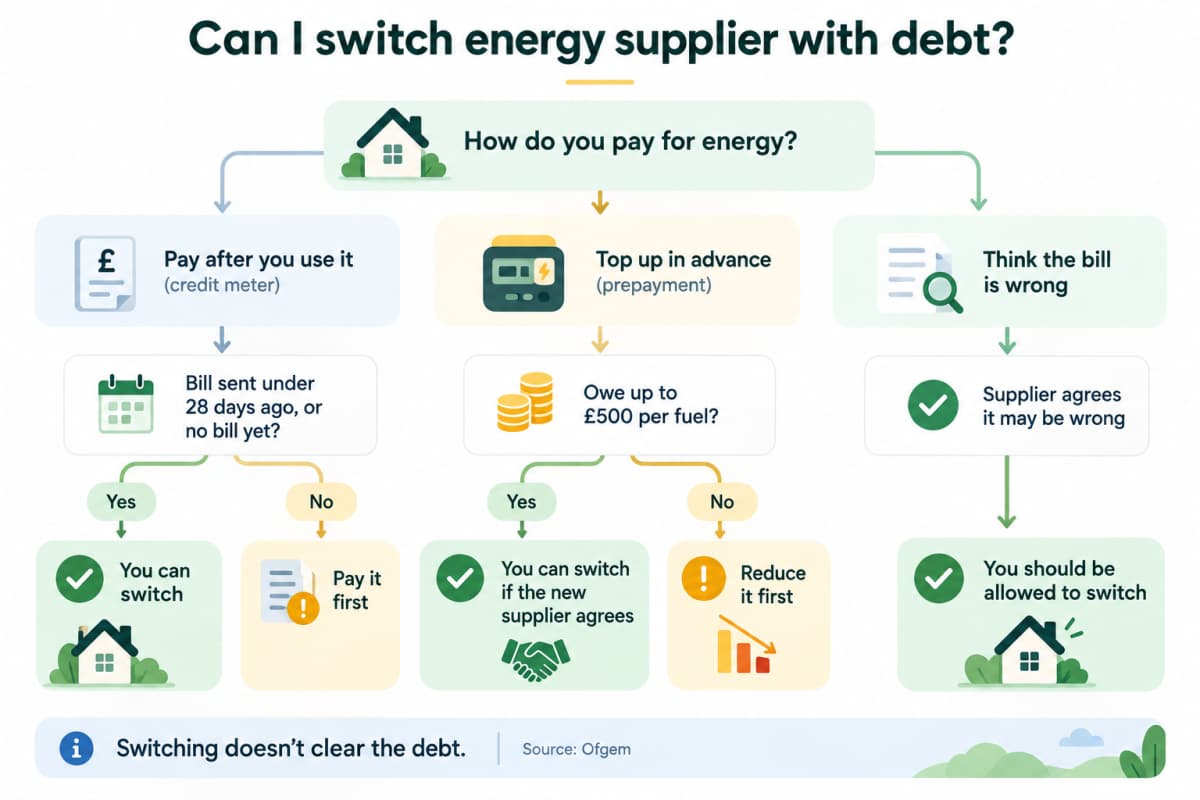
Here's a quick look at when you can and can't switch.
Your situation | Can you switch? |
Your unpaid bill is less than 28 days old | Yes, generally |
Your unpaid bill is more than 28 days old | Your supplier may block the switch |
Your account is in debit, but you have no overdue billed debt | Not automatically blocked |
You owe up to £500 per fuel on a prepayment meter | Usually, if the new supplier accepts the debt transfer |
You owe more than £500 for either fuel on prepayment | You may need to reduce the debt first |
Your supplier agrees that your bill might be wrong | You should generally be allowed to switch |
Remember, switching doesn't wipe out what you owe. You'll still need to repay the debt, either to your previous supplier or through an agreed prepayment debt transfer.
Let's look at how the rules work for each meter type.
Can You Switch With Debt on a Credit Meter?
If you pay by Direct Debit or receive monthly or quarterly energy bills, you're usually on a credit account. Even if you owe money, your supplier can't automatically stop you from switching. What matters is when you were billed.
The 28-Day Rule, Explained
Under Ofgem's 28-day rule, your supplier can block a switch because of debt only if the unpaid amount was billed at least 28 days before you requested to switch.
If the bill is newer than that, or you haven't received one yet, you can generally switch. Any outstanding amount will be added to your final bill.
For example, imagine you received a £200 electricity bill on 1 October.
Switch on 15 October: You can still switch because the bill is less than 28 days old.
Switch on 5 November: Your supplier may block the switch if the bill remains unpaid.
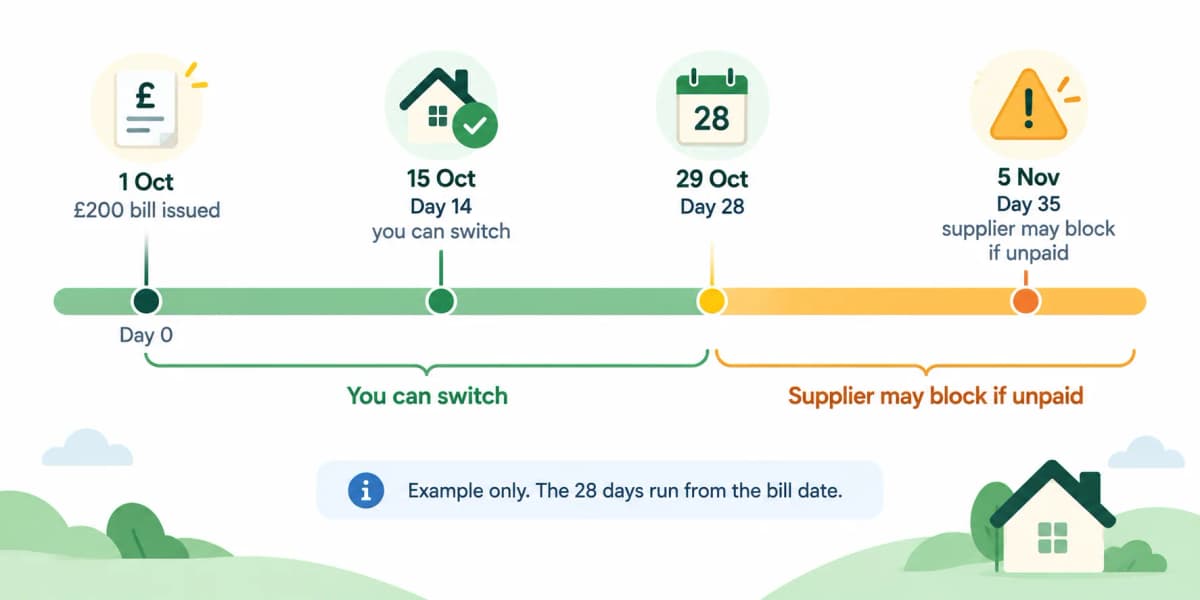
Remember, receiving a newer bill doesn't reset the clock on older unpaid bills.
When Debt Shouldn't Block You
Having a debit balance doesn't always mean you're behind on payments.
For example, you might pay £100 a month by Direct Debit but use more energy during winter. Your account could show a negative balance even though you've made every payment. That balance alone isn't enough to justify blocking your switch.
There's also an exception if you believe your bill is wrong. If you've challenged the bill and your supplier agrees there might be a mistake, they should let you switch.
If your supplier refuses, ask which unpaid bill is causing the problem and when it was issued.
Can You Switch With Debt on a Prepayment Meter?
Yes, you can usually switch energy suppliers if you owe up to £500 on a prepayment meter. Unlike credit meters, the amount you owe matters more than how long you've owed it.
The £500 debt limit applies to each fuel separately. So, if you owe £300 for gas and £400 for electricity, you can still switch, provided your new supplier accepts the debt transfer.
If you owe more than £500 for either fuel, you may need to reduce that balance before switching. The same rules apply to smart meters set to prepayment mode.
How the Debt Assignment Protocol Works
The Debt Assignment Protocol (DAP) lets you transfer eligible prepayment debt to a new supplier instead of paying it all off before switching.
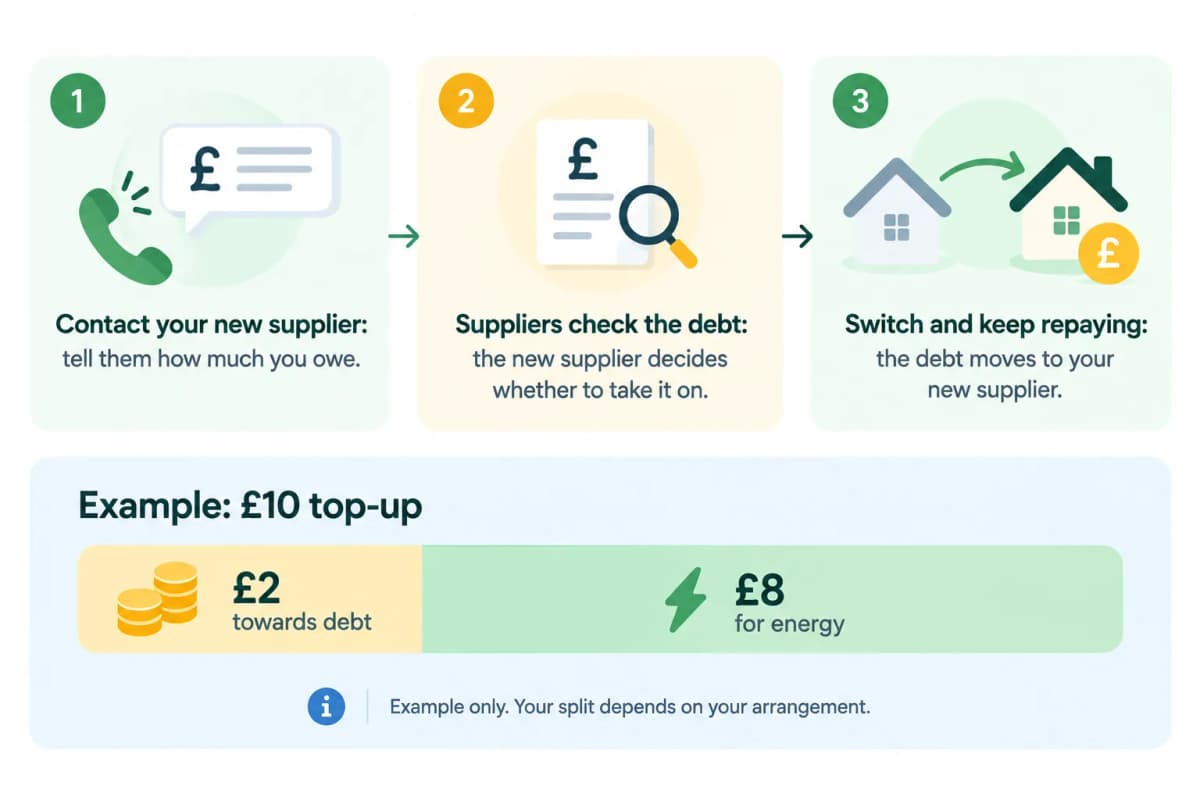
Here's how it works:
Contact your new supplier. Tell them how much you owe and ask whether they'll accept your debt through DAP.
The suppliers check your debt. Your current supplier shares the outstanding balance, and the new supplier decides whether to take it on.
Switch and continue repaying. Once agreed, your debt moves to the new supplier, and you'll repay it through your new arrangement.
For example, if you top up £10 and £2 goes towards your debt, you'll have £8 left for energy. The actual repayment amount depends on your arrangement.
Remember, not every supplier will accept a debt transfer. So check with your chosen supplier before starting the switch.
What If Your Switch Is Blocked?
You've found a better energy deal, but your supplier won't let you switch. That's frustrating, especially when you're trying to save money.
But it doesn't mean you're stuck with your current supplier. Sometimes it's an unpaid bill, a mistake in your debt balance or simply incorrect account details. The first step is to find out what's causing the problem.
What to Do, Step by Step
Ask why your switch was blocked. Contact your supplier and request the reason in writing, including how much you owe and when the unpaid bill was issued.
Check if the objection is valid. Look at the 28-day rule for credit meters or the £500 debt limit for prepayment meters. If the figures don't match, ask your supplier to review the decision.
Challenge any mistakes. If the debt is incorrect or belongs to someone else, provide evidence and ask for it to be corrected.
Ask how to remove the block. If you genuinely owe the money, ask what needs to be paid. If you can't afford it, discuss a repayment plan, although this won't automatically allow you to switch.
Try switching again. Once the issue is resolved, ask your new supplier to restart the process.
When to Go to the Energy Ombudsman
If your supplier refuses to explain the decision or you believe they've blocked you unfairly, make a formal complaint.
If the problem remains unresolved after eight weeks, or your supplier sends a deadlock letter saying it can't resolve your complaint, you can take it to the Energy Ombudsman. It's free, independent and can require suppliers to put things right.
How Long Does It Take to Switch Energy Supplier With Debt?
Once you're allowed to switch, the process is usually quite quick. Your new supplier should complete the switch within five working days, provided you choose the earliest available date.
According to Ofgem's switching rules, your new supplier handles the process, so you don't need to cancel your old energy supply yourself.
Here's what to expect:
5 working days: The usual switching time if you want to move as soon as possible.
14-day cooling-off period: You can cancel your new energy contract within 14 days if you change your mind. You can also choose to switch after this period.
Up to 6 weeks: Your previous supplier should send your final bill after the switch.
If your supplier raises a valid debt objection, your switch may be delayed until it's resolved.
Moved In? When Are You Responsible for the Energy Bill?
Moving into a new home doesn't mean taking on someone else's energy debt. You're only responsible for your own energy charges from when you take over the property—usually the start of your tenancy if you're renting, or when you take ownership if you're buying.
Take meter readings on moving day and contact the existing supplier with your move-in date. If you're charged for energy used before you moved in, ask for a corrected bill.
If there's a prepayment meter, contact the supplier before topping up. They should remove any previous occupant's debt and arrange a new key or card so you're not paying off someone else's balance.
Can Your Supplier Cut You Off While You Owe Money?
Yes, your energy supplier can cut off your gas or electricity if you don't pay your bills, but only as a last resort. Missing a payment doesn't mean you'll be disconnected straight away.
Before cutting off your supply, your supplier must follow strict disconnection rules, including:
Offering a repayment plan: Your supplier must consider what you can reasonably afford to pay.
Giving proper notice: They can't disconnect your supply without following the required warning procedures.
Considering alternatives: They may offer a prepayment meter if it's safe and suitable for your household.
Protecting vulnerable customers: Extra rules apply to some households. For example, if you've reached State Pension age and live alone, you cannot be disconnected between 1 October and 31 March.
If you're falling behind on payments, contact your supplier early to discuss your options.
Where to Get Help With Energy Debt
If you're struggling to pay off your energy debt, you don't have to figure everything out on your own. Your supplier, debt charities and support schemes may be able to help you manage what you owe.
Your Supplier Must Offer Help
Your energy supplier must work with you if you're struggling to pay. Under Ofgem's rules, you can ask for:
An affordable repayment plan
Smaller payments or more time to pay
A temporary payment break
A review of your existing debt repayments
Tell your supplier what you can realistically afford each month.
Grants and Trust Funds
Some energy companies offer grants to help customers clear outstanding debt.
For example, British Gas, EDF, E.ON Next and Octopus Energy have support funds. The British Gas Energy Trust also offers grants to eligible customers of other suppliers.
Each fund has its own eligibility rules, and some require you to get debt advice before applying.
Free Debt Advice and Breathing Space
You can get free, independent help from Citizens Advice, StepChange or National Debtline.
If you live in England or Wales, you may also qualify for Breathing Space. This gives eligible people up to 60 days of protection from certain debt collection actions while they get advice.
It won't cancel your debt, but it can give you time to work out a repayment plan.
What We Know About the Debt Relief Scheme
Ofgem has proposed a Debt Relief Scheme to help eligible households with energy debt built up between April 2022 and March 2024.
However, as of October 2026, the scheme is still awaiting a final decision. There's no confirmed start date or application process yet.
For now, contacting your supplier and checking existing support schemes is the best place to start.
Get a clearer picture of your energy costs
Switching suppliers can save money, but EnergieBee helps you understand your energy usage and where your money goes.
Is Switching Worth It If You Owe Money?
Switching could help you pay less for energy going forward, even if you still owe your old supplier money. But before moving, make sure the new deal will actually save you money.
What the Price Cap Covers (and Doesn’t)
The Ofgem energy price cap limits unit rates and standing charges on standard variable tariffs, not your total bill.
For October to December 2026, it's £1,723 a year for a typical household paying by Direct Debit. Your actual bill could be higher or lower depending on how much energy you use. Fixed tariffs aren't covered by the cap.
Check Exit Fees and Your Usage First
Before switching, compare:
Unit rates: How much you pay per kWh.
Standing charges: The daily fixed cost.
Your energy usage: How much gas and electricity you actually use.
Exit fees: What you might pay to leave a fixed deal early.
If your fixed tariff has 49 days or less remaining, you can normally switch without an exit fee.
And remember, a cheaper tariff won't erase your existing debt.
FAQs
Can I switch if I’m on a repayment plan?
Yes, you might still be able to switch. However, having a repayment plan doesn't automatically remove a debt-related block. If you have older unpaid bills, your supplier may still refuse the switch.
Will switching affect my credit score?
Switching itself doesn't automatically hurt your credit score. However, your new supplier may run a credit check, and missed energy payments could affect your credit history.
Is there a social tariff for energy in the UK?
No, there's currently no dedicated nationwide social tariff for gas or electricity. However, eligible households can receive the £150 Warm Home Discount, and some suppliers offer additional financial support.
Can I switch if I rent?
Yes, if you pay your energy supplier directly, you can usually switch without your landlord's permission. If your landlord pays the supplier and includes energy costs in your rent, you'll need to ask them to switch.
Will a new supplier ask for a deposit if I have debt?
Possibly. Your new supplier may check your credit history or ask for a security deposit before offering a credit tariff. Ask about the deposit requirements and payment options before agreeing to switch.

 Sharieaz Kavier

 David Price