Energy tariffs with no standing charge tariffs do exist, but most options in Great Britain are limited to prepayment customers. With Ofgem trialling lower standing charge tariffs and the Government planning to remove gas standing charges in 2027, here's what's available and whether switching could actually save you money.
Which Energy Suppliers Have No Standing Charge?
Currently, Utilita and E Energy are the two main suppliers offering energy tariffs with no standing charge in Great Britain. Both offer these tariffs for gas and electricity, but they're only available to prepayment customers.
Here's a quick comparison of what's available:
Supplier | Tariff | Who can get it? |
Smart Energy | Smart Pay As You Go customers | |
Easy Smart - No Standing Charge | Smart prepayment customers |
Utilita's Smart Energy tariff has no daily standing charge or exit fees. E Energy's Easy Smart tariff also removes the daily charge, but requires a smart prepayment meter.
Both suppliers charge higher rates for the first 2 kWh of gas or electricity you use each day. So, while you avoid the daily fee, you could still end up paying more overall.
If you pay by Direct Debit, neither of these tariffs is currently an option. However, some suppliers are testing lower-standing-charge tariffs, which we'll cover shortly.
How Do No Standing Charge Tariffs Work?
Normally, your energy bill has two charges: a daily standing charge and a unit rate for the electricity or gas you use. As Ofgem explains, you pay the standing charge even on days when you use no energy.
A no standing charge tariff removes that daily fee. Instead, suppliers like Utilita and E Energy charge a higher rate for the first 2 kWh of electricity or gas you use each day.
Here's how it works:
Use no energy: You pay nothing for that fuel that day.
Use 2 kWh: Both units are charged at the higher rate.
Use 5 kWh: The first 2 kWh cost more, while the remaining 3 kWh are charged at a lower rate.
The pricing resets each day. So, while you avoid a fixed daily charge, your total bill still depends on how much energy you use and when you use it.
Low Standing Charge Tariffs: What Is Available Under Ofgem’s Pilot?
If you can't get a zero standing charge tariff, there may be another option.
In June 2026, Ofgem launched a one-year pilot with four major energy suppliers: EDF, E.ON, Octopus Energy and British Gas.
Under the pilot, households using both gas and electricity could pay around £150 less a year in standing charges. However, these tariffs may have higher unit rates, so a lower standing charge doesn't always mean a lower bill.
Here's what the suppliers are offering:
Supplier | What's available | Who can get it? |
EDF | FreePhase trial, offering £6.25 off standing charges per month per fuel | Eligible new and existing customers with a compatible smart meter |
E.ON Next | Next Lower Daily Fixed, a 24-month fixed tariff with reduced standing charges | Selected existing customers who meet the eligibility rules |
Octopus Energy | A 12-month fixed tariff with lower standing charges and higher unit rates | Limited places for eligible new and existing customers |
British Gas | Fixed Lighter tariffs, reducing standing charges by around £150 annually for dual-fuel customers | Trialled with selected existing customers; wider availability not confirmed |
The important thing to remember: These aren't zero standing charge tariffs. You'll still pay a daily fee, just a smaller one.
And because places are limited, not everyone can join. Before switching, compare the full tariff cost, including unit rates and any exit fees, rather than looking at the standing charge alone.
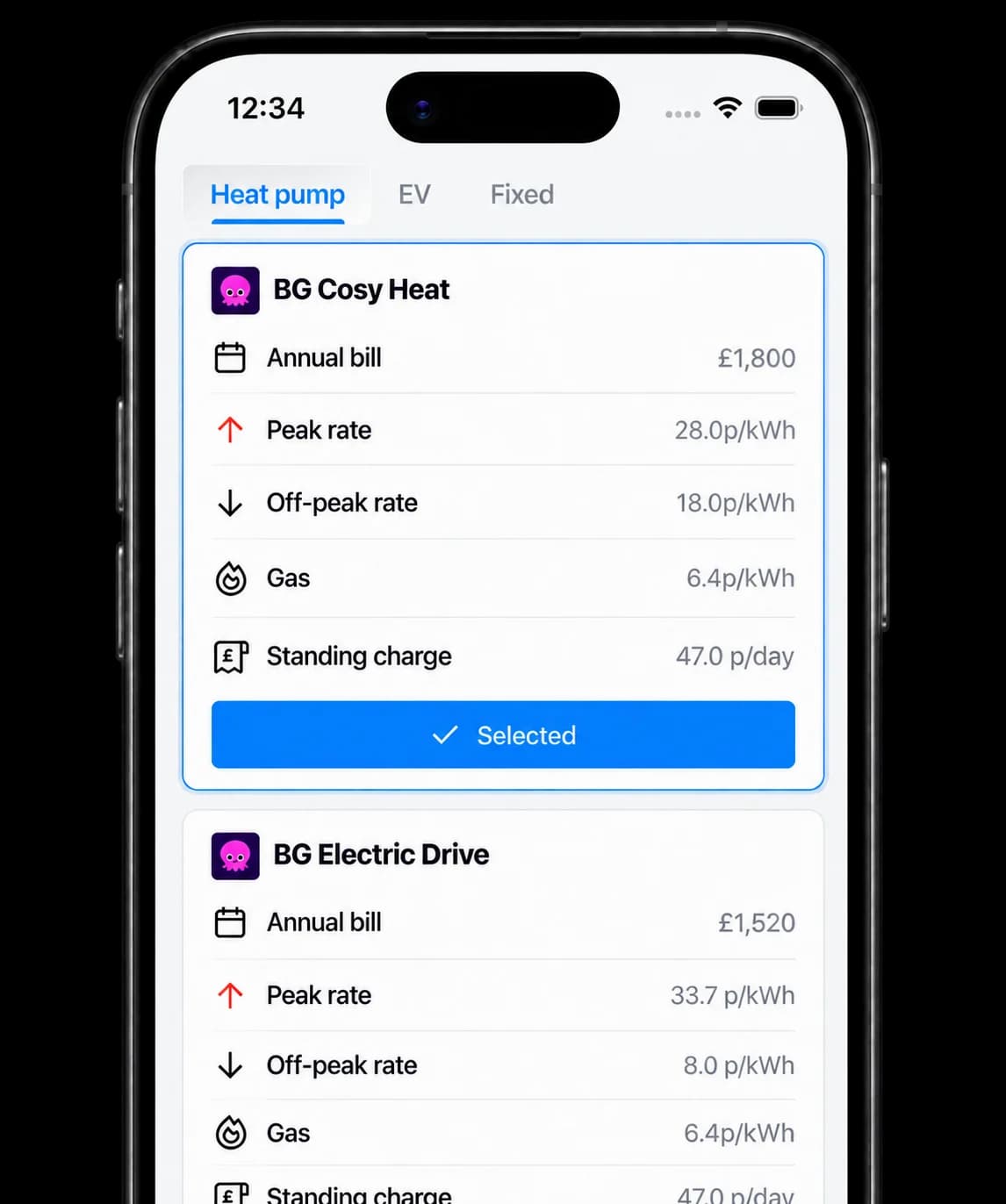
Find the right energy tariff without Guesswork
Compare energy tariffs based on your home's actual energy use and your budget. EnergieBee makes it easier to understand your options and choose a tariff that could save you money.


Download EnergieBee
Scan with your phone's camera to get the app.
Is a Tariff With No Standing Charge Worth It? Break-Even by Usage
A no standing charge tariff can save you money, but it depends on how often you use energy, not just how much you use. The real saving comes when the standing charges you avoid are greater than the extra you pay through higher unit rates.
Let's look at a real pricing example:
In London, E Energy's no standing charge tariff charges 47.10p/kWh for the first 2 kWh of electricity used each day, then 25.70p/kWh. By comparison, Ofgem's October–December 2026 price cap allows a standard London prepayment rate of 25.78p/kWh, plus a 42.92p daily standing charge.
Here's what happens when two households use the same 730 kWh of electricity a year, but on different days.
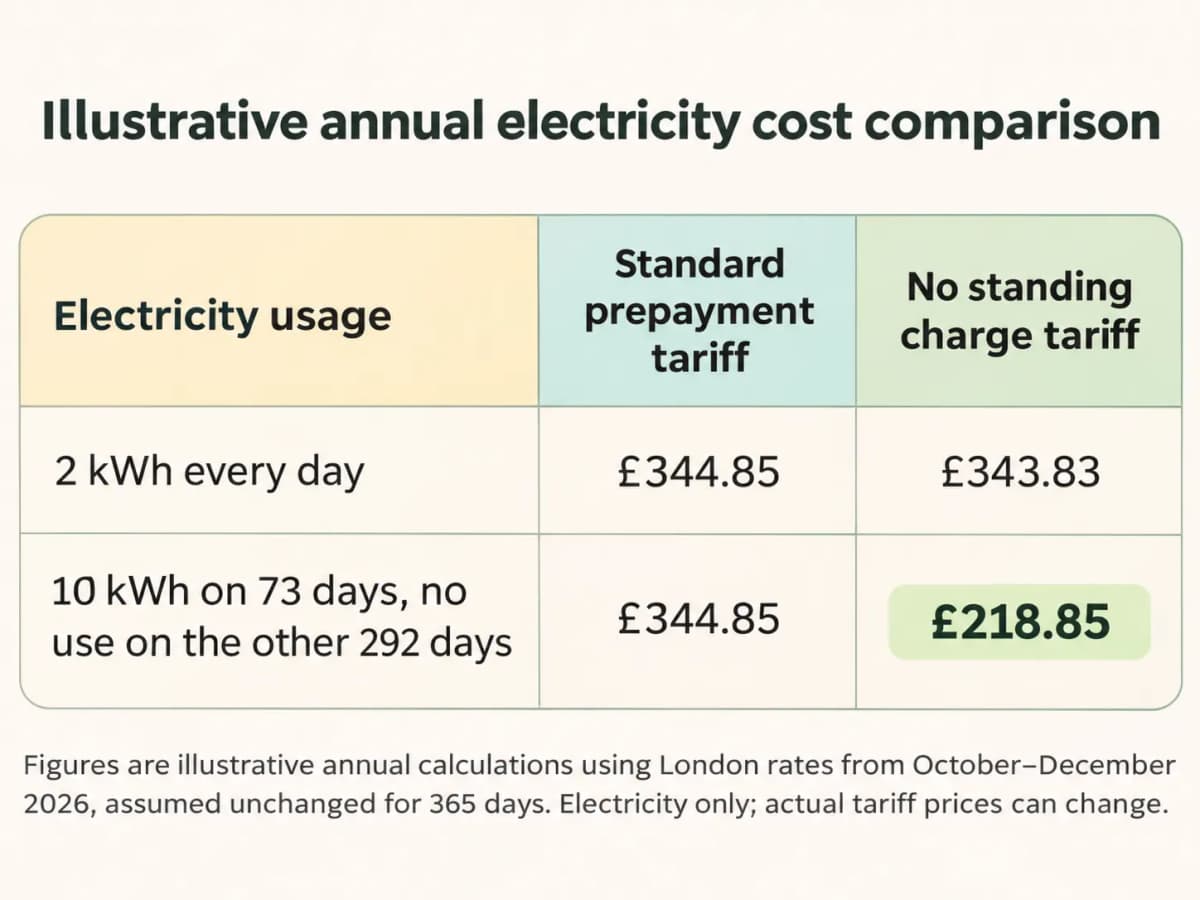
See the difference? Both households use exactly the same amount of electricity. Yet the second saves around £126 compared with the standard tariff, simply because it has more days with no electricity use.
That's why there's no single break-even point based on annual usage alone. With these tariffs, how you spread your energy use across the year matters too.
Who benefits most
No standing charge tariffs tend to work best for households that regularly go without using gas or electricity.
For example:
Holiday homes or second properties: You could save on days when the property uses no energy at all.
Homes with little summer gas use: If you stop using gas for heating and hot water during warmer months, you could avoid gas charges on those days.
Very low-energy households: You may benefit, but only if the higher unit rates don't outweigh the standing charge savings.
On the other hand, if your home uses electricity every day, even in small amounts, the savings may be limited. Homes with EVs or heat pumps should also compare the full tariff cost, as cheaper unit rates or off-peak electricity could be more valuable.
Gas Standing Charge Removal in 2027: Things You Need to Know
Good news if you're tired of paying a daily gas charge even when your heating is off.
In the October 2026 Budget, the Government announced plans to remove standing charges from household gas bills in Great Britain. But the change won't happen immediately, and it won't make gas cheaper for everyone.
Here's what we know so far.
What is confirmed
The Government has asked Ofgem to remove gas standing charges by the end of 2027, or as soon as possible afterwards.
Currently, the average gas standing charge is around £108 a year, whether you use much gas or not.
Under the new plan:
Households would no longer pay a fixed daily gas standing charge.
The costs currently covered by that charge would move into gas unit rates instead.
Your gas bill would depend more directly on how much gas you actually use.
The important part? The standing charge is being removed, but the costs behind it aren't disappearing.
What is not confirmed yet
Although the Government has announced the change, some important details are still undecided:
Exact start date: The target is the end of 2027, but implementation could take longer.
New gas unit rates: We don't yet know how much prices per kWh will increase.
Existing tariffs: It's unclear exactly how the change will affect fixed tariffs, tracker deals and prepayment customers.
Extra support: The Government has promised targeted protection for certain households, but the details haven't been announced.
So, for now, your existing gas standing charge still applies unless you're already on a tariff without one.
Who saves and who pays more
According to the Government's estimates, around 60% of households with gas accounts could save an average of £45 a year.
But not everyone will benefit equally.
Household | Likely impact |
Low gas users | Could save money by avoiding the fixed daily charge |
Homes using little or no gas in summer | Could benefit from paying less during low-use months |
Average gas users | Many could save, depending on the new unit rate |
High gas users | Could pay more because each unit of gas may cost more |
These are expected outcomes, not guaranteed savings. Your actual bill will depend on your gas consumption and the final pricing rules.
Will scrapping the gas standing charge make these tariffs pointless?
Not necessarily. Removing standing charges from standard gas tariffs could reduce the appeal of today's specialist zero-standing-charge deals.
But suppliers may still offer different unit rates, payment options and tariff conditions. So the cheapest option will still depend on how you use energy.
And remember, the announced removal only covers gas. Electricity standing charges are being considered separately.
For now, there's no need to rush into a new tariff just because of the 2027 announcement. Compare what's available today and choose based on your actual energy costs.
No Standing Charge Electricity: What Happens to the Electricity Standing Charge?
Unlike gas, electricity standing charges aren't confirmed to be removed in 2027. The Government has promised separate reforms, with more details expected next year.
For now, here's what you need to know:
Current charge: An average of 54.83p a day, or around £200 a year, under Ofgem's October–December 2026 price cap.
Future changes: The Government plans to reform electricity standing charges, but hasn't confirmed how or when they'll change.
What you pay now: Standard electricity tariffs still include a daily standing charge, even when you use no electricity.
Do solar panels or a home battery help?
Yes, they can lower your electricity bills, but they won't automatically remove your standing charge.
Solar panels: Generate electricity so you buy less from the grid.
Home batteries: Store surplus solar electricity to use later, reducing grid purchases.
Standing charges: You still pay the daily fee on a standard tariff, even if you use no grid electricity.
If your solar panels and battery keep your grid usage low, a no standing charge tariff might be worth comparing. Just check whether higher unit rates could cancel out the savings.
Should You Switch to a Low or No Standing Charge Tariff Now or Wait Until 2027?
You don't need to wait until 2027 if switching could save you money today. The planned gas standing charge removal won't happen immediately, and its effect on different tariffs is still uncertain.
Here's what to consider before making a decision:
If you use very little energy: A low or zero standing charge tariff could save you money now, especially if you have days with no usage.
If you use energy every day: Compare the total cost carefully. A standard tariff with lower unit rates might work out cheaper.
If you're on a fixed tariff: Check your contract and exit fees before switching. Don't assume the 2027 changes will automatically reduce your fixed charges.
If you're thinking of waiting: Remember, Ofgem's price cap changes every three months, so energy prices could rise or fall before the reforms take effect.
The bottom line: Don't choose a tariff based on its standing charge alone. Compare what you'd pay over a full year, including unit rates, standing charges and any exit fees.
If a better deal is available now, there's no need to put off switching just because changes are coming in 2027.
Frequently Asked Questions
Does Octopus have a no standing charge tariff?
Yes. Octopus Zero Bills has no standing charge, but it's only available to approved homes with solar panels, battery storage and a heat pump. It's not a standard tariff anyone can switch to.
Can I get an energy tariff without a standing charge on a smart or prepayment meter?
Yes, but you'll need an eligible prepayment tariff. Utilita and E Energy offer zero standing charge options, with E Energy requiring a smart prepayment meter. Having a smart meter alone doesn't qualify you.
Can you get no standing charge electricity in Northern Ireland?
Yes. Power NI's Home Energy tariffs have no additional standing charge. However, its Economy 7 and EV tariffs do include one.
Will my fixed tariff change when the gas charge goes?
Not necessarily. The Government hasn't confirmed how the 2027 reforms will affect existing fixed contracts. For now, your agreed tariff terms still apply unless your supplier confirms a change.
Are standing charges the same everywhere?
No. According to Ofgem, standing charges vary by region, payment method and tariff. Check your postcode and supplier's rates to see what applies to your home.

 Sharieaz Kavier