
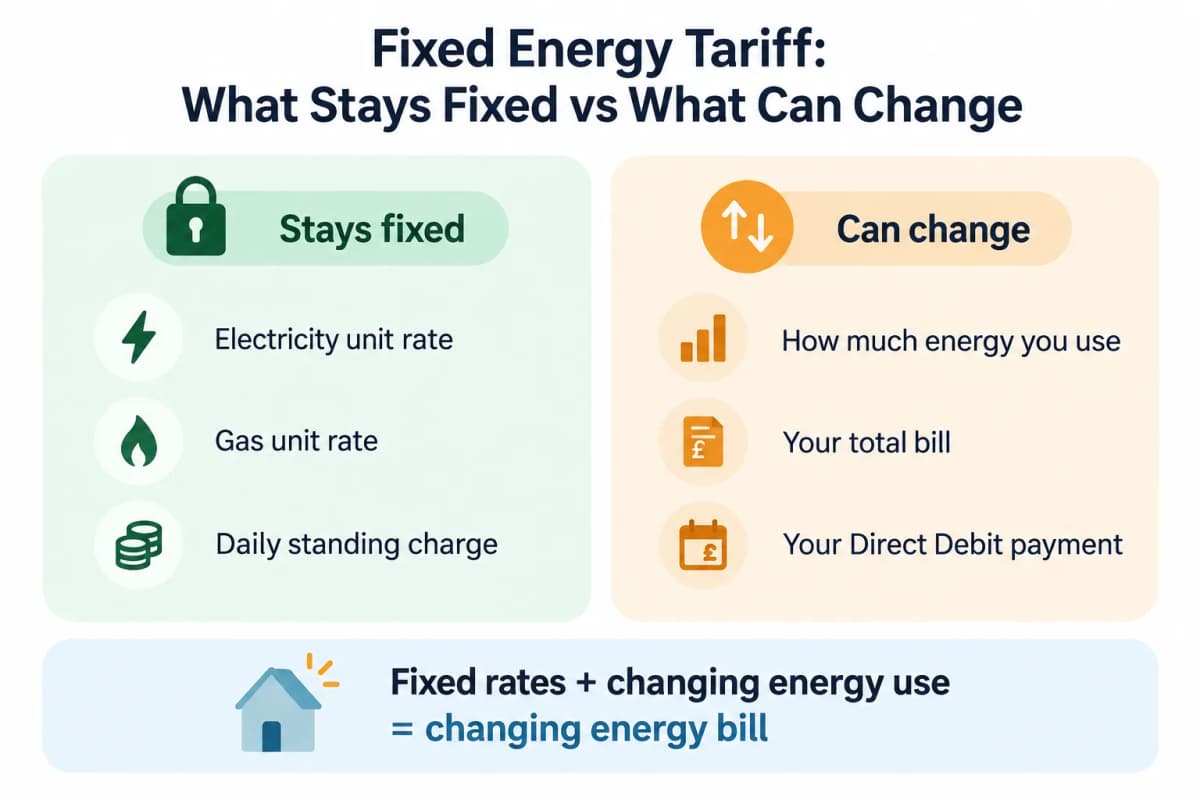
A fixed tariff locks in your energy unit rates and daily standing charge for an agreed period, not your total bill. So even when those rates stay the same, turning up the heating or using more electricity can leave you paying more.
In this guide you will know what a fixed tariff means, why your bill can still change and what to check before choosing a deal for your home.
What Is a Fixed Energy Tariff?
A fixed energy tariff is a contract with your supplier that sets your energy rates for an agreed period. Those rates won’t change just because market energy prices rise or fall.
For example, say you choose a 12-month deal at 25p per unit of electricity. If your supplier’s variable rate later rises to 30p, you’ll still pay 25p per unit until your fixed deal ends.
You can fix electricity alone or choose a dual-fuel deal, which covers both gas and electricity from the same supplier.
How Do Fixed Rate Energy Tariffs Work?
Your supplier calculates your bill using your agreed rates and the energy you use. There are two main charges to understand.
Unit Rates and Standing Charges
Your unit rate is the price you pay for each kilowatt hour (kWh) of gas or electricity you use.
Your standing charge is a separate daily fee. You pay it even when you use no energy, so switching everything off while you’re away won’t remove this charge.
How Long Does a Fixed Tariff Last?
Fixed tariffs usually last one or two years, although the exact length depends on the deal.
Check the contract’s end date before signing up. A longer fix means keeping those rates for longer, not necessarily getting a better price.
Does a Fixed Tariff Mean Your Energy Bill Stays the Same?
No. Your bill can still change, but fixed rates make your energy costs easier to plan. And when you use less energy, you can bring your bill down without waiting for prices to fall.
Here’s an example using an illustrative electricity rate of 25p/kWh and a 50p daily standing charge:
Electricity used over 30 days | Usage cost | Standing charges | Total bill |
200 kWh | £50 | £15 | £65 |
300 kWh | £75 | £15 | £90 |
The extra 100 kWh adds £25 to your bill, even though the rates haven’t changed.
Your monthly Direct Debit isn’t guaranteed either. Your supplier may increase your payments if you’re using more energy than expected.
Our guide to the cheapest fixed energy tariffs in the UK can help you narrow down your options. Before signing up, get a personalised quote from the supplier.
Fixed vs Variable Energy Tariffs: What's the Difference?
A fixed tariff keeps your agreed rates steady, while a variable tariff allows them to rise or fall. Choosing between them can feel tricky when you want a good price without unexpected changes.
Here’s how a fixed deal compares with a standard variable tariff:
What happens? | Fixed tariff | Standard variable tariff |
Energy prices rise | Your agreed rates stay the same | Your rates may increase |
Energy prices fall | Your rates won’t automatically drop | Your rates may decrease |
You find a better deal | An exit fee may apply | You can leave without an exit fee |
The reassuring part? Neither choice has to be permanent. You can switch later, just check any exit fees before moving from a fixed deal.
Are Fixed Energy Tariffs a Good Idea? Pros and Cons
A fixed energy tariff can be a good choice if you want predictable rates and find a deal that suits your budget. It gives you one less thing to worry about, but it isn’t automatically the cheapest option.
The benefits: Knowing your rates makes planning your energy costs easier. You can budget around your usual usage without worrying about every market price rise.
The drawbacks: You could miss out on cheaper rates later. An exit fee may also reduce or wipe out, the savings from moving to a better deal.
Here’s a simple table to help you weigh up the pros and cons of a fixed energy tariff:
Pros | Cons |
Protection from price rises: Your agreed rates stay steady when market prices increase. | No automatic price cuts: You won’t benefit automatically if market prices fall. |
Easier budgeting: Knowing your rates helps you plan around your usual energy use. | Not always better value: Another fixed deal or a variable tariff could cost less. |
Less to worry about: You don’t need to follow every market price change. | Possible exit fees: Leaving early could reduce the savings from switching to a cheaper deal. |
Before signing up, compare the yearly cost using your own energy usage, then check the contract length and any exit fees. The right deal should feel manageable, not just sound reassuring.
How Do I Know If I'm on a Fixed or Standard Variable Tariff?
Check your latest bill or online supplier account for your tariff type and end date. Look for a section called “Tariff details” or similar.
A fixed deal will usually show when your contract ends. A standard variable tariff may also be described as your supplier’s “default” tariff.
If the wording isn’t clear, there’s no need to guess. Ask your supplier: “Are my unit rates and standing charges fixed, and until what date?”
How to Compare Fixed Energy Tariffs Before Choosing One
Start with your annual energy use, not the advertised monthly payment. Here’s a simple way to compare your options:
Have your details ready. Find your postcode and yearly gas and electricity use in kWh.
Compare yearly costs. Use the same usage figures for every quote.
Check the small print. Look at contract length, exit fees and any meter requirements.
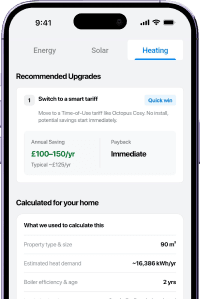
EnergieBee brings available plans into one app. Choose a supplier and select Fixed. You can then check estimated yearly bills, energy rates and standing charges together.
Make Your Next Tariff Choice Simpler
EnergieBee helps you compare fixed tariff costs without jumping between different supplier websites.