

Choosing the wrong solar panel installer costs more than a bad quote. A rushed pitch or a corner-cutting installer can mean a voided warranty, a leaking roof, or a system that underperforms.
The good news is that choosing the right installer doesn’t have to be complicated. We turned the most crucial solar installer concerns into this simple checklist.
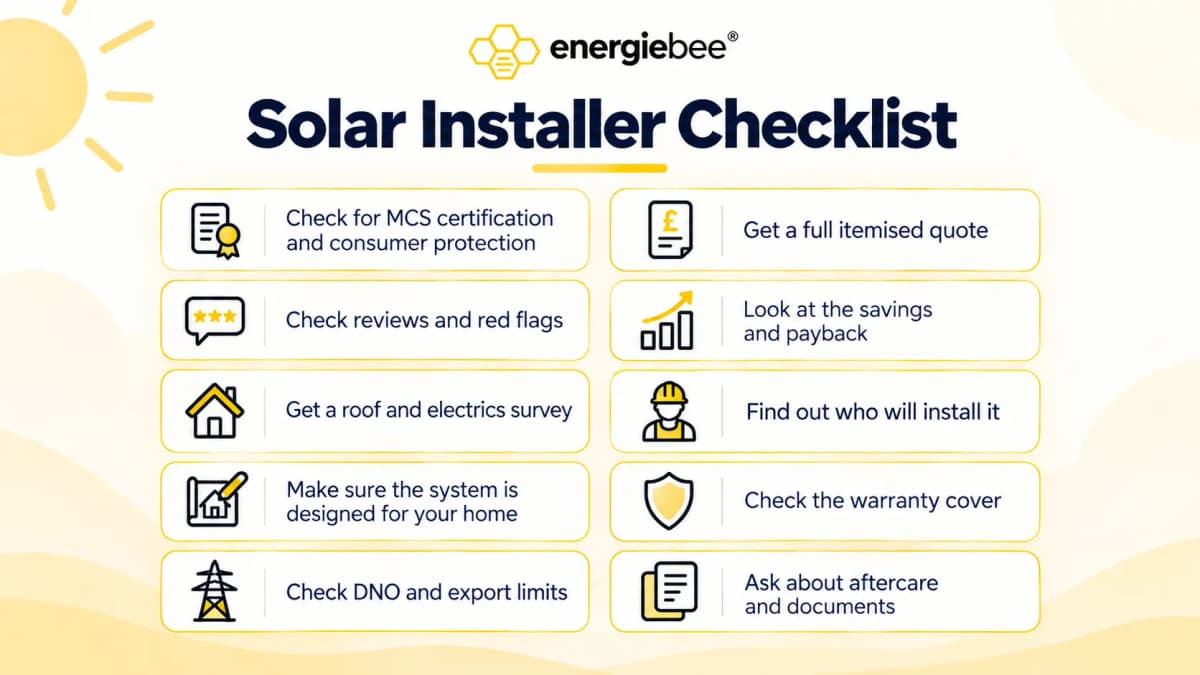
This guide breaks down 10 things to check when choosing a solar company in the UK, so you can make a confident decision without getting lost in technical details.
How to Choose the Right Solar Installer for You
A good solar installer should be easy to verify and easy to understand. Use this checklist to compare the essentials before you sign.
1. Check Their MCS Certification and Consumer Protection
Before comparing prices, make sure you are dealing with a certified solar installer. Start with two checks: MCS certification and RECC membership.
Check | Why it matters |
MCS certification | Shows the installer is certified to recognised standards for solar PV installation. It is also commonly needed for SEG applications and some funding schemes. |
RECC membership | Adds consumer protection around sales, contracts, deposits, workmanship warranties and after-sales service. RECC members must protect deposits and workmanship warranties if they stop trading. |
Before you sign for your solar installer:
Search the installer on the official MCS register.
Confirm they are certified for Solar PV.
Check whether they are listed as a RECC member.
Don’t rely only on logos shown on the installer’s website.
RECC also advises homeowners to get at least three quotes and never pay more than 25% of the contract price upfront.
2. Check Customer Reviews and Watch for Red Flags
Check recent reviews on Google and Trustpilot, but look beyond the star rating. Focus on repeated comments about workmanship, delays, costs and aftercare.
Watch for these red flags:
Doorstep or cold-call pressure
“Sign today” discounts
A price that suddenly drops when you hesitate
Pressure to pay a deposit immediately
Refusal to give you time to compare quotes
Which? says reputable solar companies should give you time to consider the quote and should not use large time-limited discounts or pressure-selling tactics.
A good installer should be comfortable giving you time to think.
3. Make Sure They Properly Survey Your Roof and Electrics
A satellite-image quote can be useful at the start, but it should not replace a proper site survey.
What they should check | Why it matters |
Roof condition | Weak tiles or damage can cause problems during installation |
Roof angle and direction | Affects how much sunlight the panels receive |
Shading | Trees, chimneys and nearby buildings can reduce output |
Consumer unit and meter | Confirms your electrical setup can support the system |
Cable routes | Helps avoid awkward or costly installation changes |
Access and scaffolding | Can affect the final price and installation plan |
A proper survey gives a more realistic system design and helps prevent unexpected costs later.
4. Check the System Is Designed Around Your Home
Avoid one-size-fits-all solar packages. A good installer should design the system around your actual roof, including available space, shading, panel layout and inverter size.
The number of panels should also reflect how many solar panels your home actually needs, not just what fits into a standard package.
Think About Future Energy Needs
Don’t size the system around today’s electricity use alone. If you may add a battery, EV charger or heat pump, tell the installer now. These can change how much electricity your home uses, so the system should leave enough flexibility for future upgrades without needing major changes later.
5. Ask About DNO Approval and Export Limits
Your DNO (Distribution Network Operator) is the company that manages the local electricity network. Some solar systems need approval before they can connect or export power to the grid.
A good installer should handle this for you and explain:
Whether approval is needed
When the application will be submitted
6. Compare the Full Quote, Not Just the Final Price
The cheapest quote can become expensive if key costs are missing. Compare what you are actually getting, not just the final number.
H3: Check Exactly What Is Included
Make sure the quote clearly lists scaffolding, electrical work, installation, certification paperwork and VAT. If something is not itemised, ask before you sign.
H3: Compare the Equipment Too
Two quotes at the same price can still be very different. Compare the panel and inverter brands, specifications and warranties so you know whether you are looking at the same level of system.
7. Question the Generation, Savings and Payback Figures
Don’t accept a big savings number without asking how it was calculated.
A reliable installer should explain the assumptions behind it, including your electricity use, tariff, expected solar generation, self-consumption and export rate.
Ask to see:
Estimated annual generation
Expected yearly savings
Export income assumptions
Estimated payback period
If the payback looks unusually fast, ask what needs to be true for that number to work. A good estimate should be easy to explain, not just impressive on paper.
8. Check Who Will Actually Install Your Solar Panels
Ask whether the company uses its own installation team or subcontractors. Both can work well, but you should know who will actually be on your roof and who is responsible if something goes wrong.
Reliable domestic solar panel installers should be able to explain who carries out the work, who supervises it, and who you contact afterwards if there is a problem.
9. Understand What the Warranties Cover
Solar warranties are not all the same. Check these three separately:
Product warranty: covers faults in equipment such as panels or inverters.
Performance warranty: covers how well the panels are expected to perform over time.
Workmanship warranty: covers problems caused by the installation itself.
Also ask what happens if the installer goes out of business. RECC members must protect their workmanship warranties, usually through an Insurance Backed Guarantee (IBG), so valid cover can continue even if the installer stops trading.
10. Agree What Happens After Installation
Before you sign, ask what support you’ll get after the system is switched on. Good aftercare should cover faults, monitoring issues and warranty claims.
Check What Documents You’ll Receive
You should receive your MCS certificate, DNO paperwork, warranty documents and system information. Also confirm who you should contact if something goes wrong later, and what maintenance is expected, including how to clean your solar panels safely.
Choosing the right installer is the single biggest factor in whether your solar system performs the way you were told it would. Get at least three quotes and don't sign until every point checks out.
FAQs About Choosing a Solar Panel Installer
How do I find a trustworthy, MCS-certified solar installer near me?
Start with the official MCS installer database at mcscertified.com, it's the only fully verified list. Cross-check any name against Google and Trustpilot reviews before contacting them, and confirm they're also RECC or HIES members for extra consumer protection.
What questions should I ask a solar panel installer before hiring them?
Ask for their MCS number, a physical site survey (not a Google Earth quote), an itemised quote, what the warranty covers, who handles the DNO application, and what happens to your warranty if they go out of business.
Is a local or national solar installer better?
Neither is automatically better. Compare their MCS status, recent reviews, survey quality, system design, warranties and aftercare. A reliable local installer can be just as suitable as a large national company.
How many solar panel quotes should I get?
Get at least three quotes before choosing an installer. This makes it easier to compare system design, equipment, warranties and total costs rather than judging one offer in isolation.