
The number of solar panels you need depends on your electricity use, roof space, panel efficiency and location, not just your home size.
For most UK homes, a typical solar system uses around 10 -14 panels, but larger households with higher electricity use may need more. The right number is the one that matches your actual energy needs, rather than simply installing as many panels as your roof can fit.
This guide will help you understand how many solar panels your home needs and what factors affect the final number.
✨ Key Takeaways +
- Your electricity use matters more than your home size. A larger house does not always need more solar panels.
- Most UK homes need around 10–14 solar panels. The exact number depends on your usage, roof space and panel output.
- The biggest system is not always the best choice. A well-sized system gives better value by matching your actual energy needs.
- Your current electricity usage is the best starting point. Check your bills or smart meter data before choosing a solar system size.
How Many Solar Panels Do You Need Based on Your Electricity Use?
The number of solar panels your home needs depends on two things:
How much electricity you use
How much energy one panel can generate
A solar panel’s annual output can vary depending on its efficiency, roof direction, shading and location.
The Renewable Energy Hub provides an easy calculation method to find out how many solar panels your house needs.
Simple way to estimate your requirement is:

For example, if your home uses 3,500kWh of electricity per year and one solar panel can generate around 350kWh annually, you would need roughly:
3,500 ÷ 350 = 10 solar panels
Here is a rough guide based on typical UK household electricity usage:
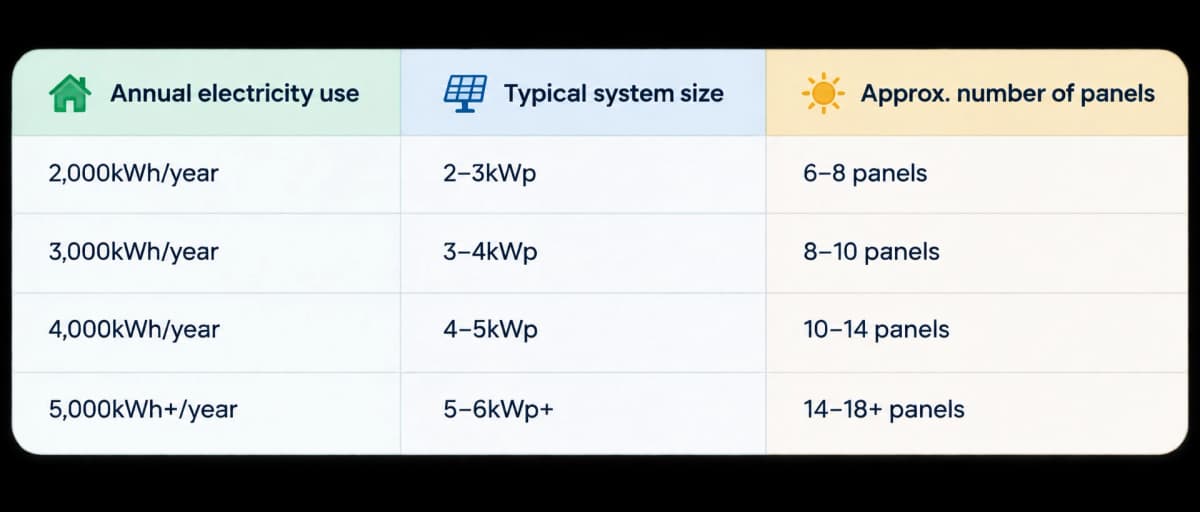
*Figures are estimates and can vary depending on panel efficiency, roof direction, shading and location. Solar generation estimates are normally calculated using factors such as system size, location, orientation and shading.
Free Solar Panel Calculator: Estimate How Many Panels Your Need
Not sure how many solar panels your home needs? The Energy Saving Trust’s solar panel calculator can give you a more personalised estimate based on your property, energy use and location.
It can estimate how many panels you may need, potential installation costs and how much you could save on your electricity bills.
Try the free Solar Panel Calculator →
Use the result as a starting point, then speak to a certified installer for a more detailed assessment of your roof and solar setup.
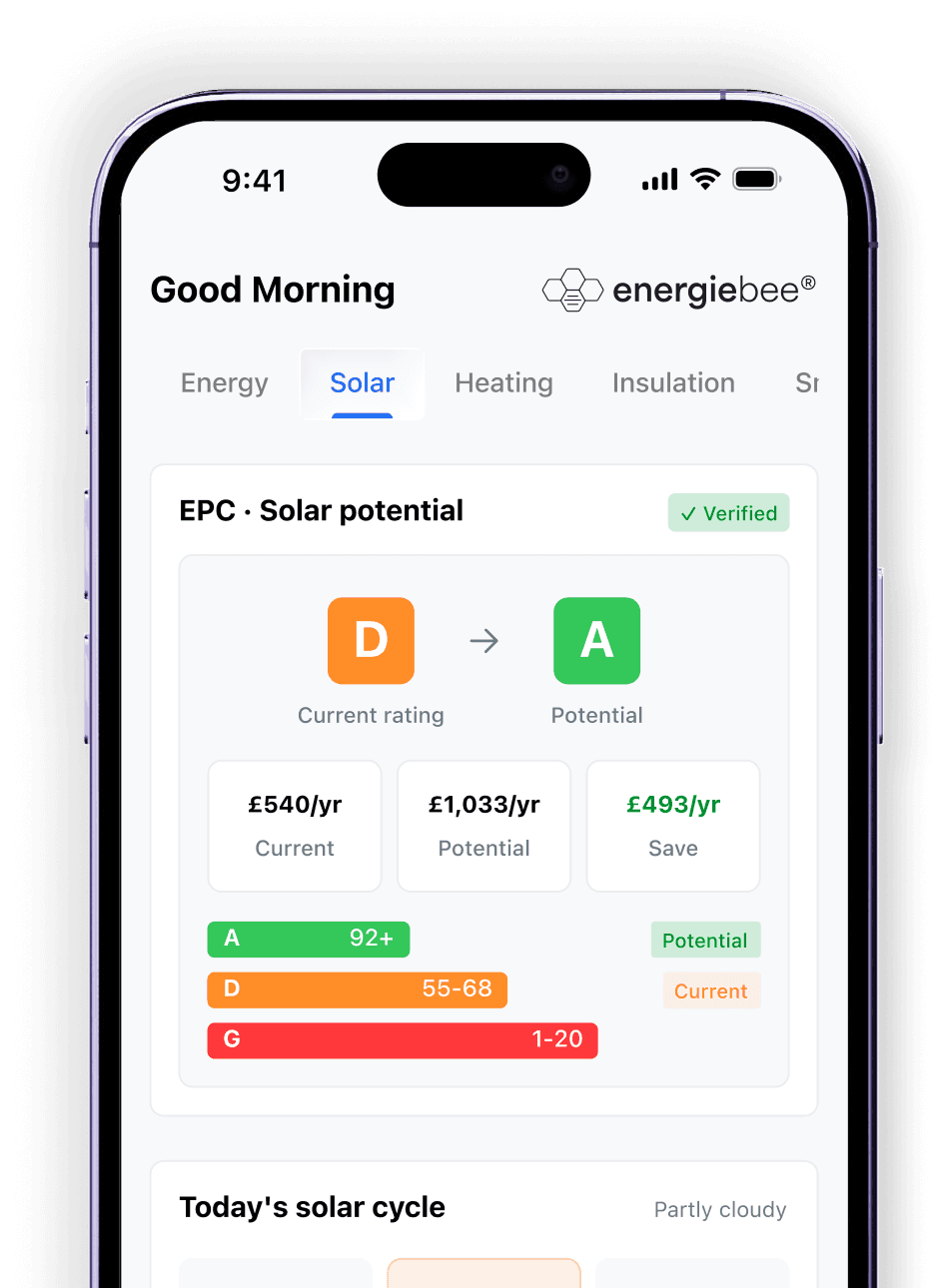
EnergieBee helps you monitor solar production, energy use and savings from one dashboard.
See where your solar energy goes
Track how much solar energy your home produces and see how much you use, save or send to the grid — all in one place with EnergieBee.
How Much Electricity Does Your Home Use?
The first step is to check how much electricity your home uses. You can find this from your previous energy bills or smart meter data.
To use the calculation, you need your average daily electricity usage. If your bill shows a monthly figure, divide it by 30. If it shows annual usage, divide it by 365 to get your daily average.
For example, a home using 3,600kWh per year uses roughly 10kWh per day on average.
Does Your UK Location Affect How Many Solar Panels You Need?
A common concern is that homes in Scotland or northern England cannot generate enough solar energy. But the difference is much smaller than many people think.
Scotland does not get half the solar generation of the South East, it is typically around 15–25% lower depending on location, roof direction and system setup.
Solar panels work across the whole UK. Your location affects how much electricity each panel can generate. But factors like roof direction, shading and panel angle can have an even bigger impact on your final output.
Here is a rough guide stated by Solar showing how solar generation varies across UK regions:
UK region | Typical solar output (kWh per kWp/year) |
South East England | ~940 kWh/kWp |
East of England | ~940 kWh/kWp |
South West England | ~940 kWh/kWp |
London | ~920 kWh/kWp |
East Midlands | ~890 kWh/kWp |
Wales | ~880 kWh/kWp |
West Midlands | ~870 kWh/kWp |
Yorkshire & Humber | ~870 kWh/kWp |
North East England | ~860 kWh/kWp |
North West England | ~820 kWh/kWp |
Scotland | ~750–850 kWh/kWp* |
*Scotland varies significantly by location. Southern Scotland generally performs better than northern areas
How Much Solar Do You Need for Common Household Loads?
It’s important to consider which appliances and energy systems you have at home. A heat pump, EV or electric boiler can significantly increase your electricity use and, in turn, the number of solar panels you may need.
A practical way to estimate this is to look at how often you use each appliance and how much electricity your solar panels can generate.
Hot Water and Immersion Heaters
Hot water can be a meaningful electricity load, particularly if you use an immersion heater. A 1,000–2,000kWh annual demand would be roughly equivalent to 3–6 panels generating 350kWh each per year.
Fridges and Freezers
Energy Saving Trust gives an example of a fridge-freezer using around 292kWh per year. That is roughly equivalent to 1 solar panel producing around 350kWh annually.
Electric Boilers
Electric boilers are harder to give a single figure for because their consumption depends heavily on the home's heating demand. Direct electric heating can have high running costs because it uses electricity directly.
4,000–8,000kWh/year would represent roughly 10–20 panels at 350kWh annual generation per panel.
TVs and Entertainment Devices
Energy Saving Trust gives an example of a 60-inch TV using around 286kWh per year. That works out at roughly 1 solar panel using the same 350kWh annual-output assumption.
EV Charging at Home
EV electricity use depends mainly on how far you drive and your car's efficiency. As an example, 2,000–3,000kWh per year for home charging would be equivalent to around 6–9 panels at 350kWh of annual generation per panel.
Heat Pumps
A typical UK home with a heat pump may need around 3.5kWp of solar capacity to generate a similar amount of electricity over a year. With 400–450W panels, that works out at roughly 8–9 panels.
Powering Your Whole Home With Solar
Energy Saving Trust states 2,900kWh per year as its typical household electricity-use assumption. That's roughly equivalent to 8–9 panels if each panel generates around 350kWh annually.
But remember, this is an annual energy comparison, not an off-grid calculation. Your solar system will generate different amounts throughout the day and year.
How Much Do Solar Panels Cost in the UK?
The solar panel cost depends on how much solar capacity you need. A 450W panel gives you more power per panel than a 350W panel, so you need fewer panels to reach the same system size.
Here is a rough guide based on typical household size and current panel pricing:
Household size | 450W panels | 350W panels | Estimated Panel cost* |
1–2 bedrooms | 6–7 | 8–9 | £420–£630 |
3 bedrooms | 9–10 | 12–13 | £630–£910 |
4 bedrooms | 11–13 | 15–17 | £770–£1,190 |
5+ bedrooms | 14–16 | 18–21 | £980–£1,470 |
*Estimated panel-only cost, excluding installation, inverter, mounting equipment, scaffolding and other system components. Prices vary by brand, panel efficiency and supplier.
A quick example:
A 3-bedroom home targeting around 4kWp could use:
9 × 450W panels = 4.05kWp
12 × 350W panels = 4.2kWp
So the 450W option needs fewer panels and less roof space, while the 350W option uses more panels to achieve a similar system size.
What Planning and Grid Rules Apply to Solar Panels?
Once you know how many panels you need, there are a few rules to check before installation. Most standard home solar installations are straightforward, but planning rules and grid connection requirements can change depending on the property and system size.
Do You Need Planning Permission for Solar Panels?
In England, many domestic solar installations fall under permitted development rights, so you may not need to make a planning application if the installation meets the relevant conditions. However, different rules can apply to listed buildings, conservation areas and other protected locations.
If you're unsure, check with your local planning authority before installation. GOV.UK also recommends checking the specific planning rules for your area.
Up to 3.68kW: The installation can generally be connected under G98, with the network operator notified afterwards.
Above 3.68kW: The installation normally falls under G99, meaning the installer needs to apply to the network operator before connection.
What Is the 3.68kW Grid Connection Threshold?
If your home has a standard single-phase electricity supply, 3.68kW is the key threshold for the simpler G98 grid connection process. It corresponds to 16 amps per phase under the Energy Networks Association's rules.
One useful detail: the 3.68kW limit relates to the inverter's registered capacity, not necessarily the total panel capacity. So an installer can potentially fit more panel capacity behind a 3.68kW inverter, depending on the system design.
Why Does MCS Certification Matter?
MCS certification provides an independent certification framework for installers and small-scale renewable energy installations. It covers the design, installation, commissioning and handover of solar PV systems.
It can also matter if you want to receive Smart Export Guarantee (SEG) payments. Ofgem says installations up to 50kW generally need an MCS certificate or equivalent certification to meet the SEG eligibility requirements.
What If You Cannot Fit Enough Rooftop Solar Panels? Can Plug-In Solar Really Help?
As of 27 August 2026, compliant plug-in solar systems can legally be bought and used in Great Britain, subject to the new requirements.
If your roof is too small, shaded or unsuitable for rooftop solar, plug-in solar can be a smaller alternative.
How Many Plug-In Solar Panels Can You Have?
The current specification allows one plug-in solar product per household, with a maximum output of 800VA. A product can contain multiple panels as long as the total system stays within the limit.
How Much Electricity Can a Plug-In Solar Kit Generate?
The government estimates this could cover up to 20% of an average home's electricity use, with potential savings of up to £110 a year. Actual results vary by home and usage.
Plug-In Solar vs Rooftop Solar: What’s the Difference?
The main difference is scale and installation. Plug-in solar is a small system designed to connect to a standard household socket, while rooftop solar is a larger PV installation connected as part of your home's electrical system.
Plug-in solar | Rooftop solar | |
Typical maximum | Up to 800VA | Much larger systems possible |
Installation | Designed to plug into a socket | Installed and wired by an installer |
Roof required | No | Yes |
Best suited to | Smaller spaces | Higher energy needs |
Why Plug-In Solar May Not Qualify for SEG Payments
The Smart Export Guarantee (SEG) requires eligible installations to meet specific requirements, including certification. For solar installations up to 50kW, Ofgem says you normally need an MCS certificate or equivalent certification.
Plug-in solar is designed under a separate product specification and does not automatically meet those SEG requirements. So you should not assume that a plug-in kit will qualify for SEG payments. Check the latest requirements with your chosen supplier before buying.
What to Check Before Buying a Plug-In Solar Kit
Before buying Plug-in solar panel, check that:
The product meets the current UK specification.
Total output stays within 800VA.
You use only one plug-in solar product per household.
Your home's electrical setup is suitable.
Bottom Line: How Many Solar Panels Are Right for Your Home?
There is no single number of solar panels that works for every home. The right number depends on your annual electricity use, panel output, roof space, location and how much of your energy you want to generate yourself.
Use your current electricity use as the starting point, then consider future loads such as an EV, heat pump or electric boiler. A larger system is not automatically better, it should make sense for your home, budget and expected energy use.