
Europe is racing to build data centres for digital sovereignty. Meanwhile the water and energy costs are sparking protests. So what is really at stake?
A race that started late
Europe began building large-scale data centres years behind the United States, and it's now trying to close that gap at speed. The motivation isn't purely commercial. Governments and companies across the continent want their data — and increasingly, the computing power behind artificial intelligence — hosted within Europe itself, rather than relying on American infrastructure. That goal has a name: digital sovereignty.
Building this independence, though, draws on resources already under strain across much of Europe: water and electricity.
What the official figures show
Just how large Europe's ambitions are became obvious this year, when the European Commission confirmed it wants to triple the bloc's data centre capacity within the next five to seven years and is now working on a Cloud and AI Development Act designed to simplify construction permits. Citing figures from the International Energy Agency, the Commission notes that data centres consumed 68 terawatt-hours (TWh) of electricity across the EU in 2024; by 2030, that figure could climb to 114 TWh, more than 3% of all electricity used in Europe.
Installed data centre capacity in the EU could similarly rise from 12 gigawatts (GW) last year to 28 GW by 2030, whilst a report from the Danish firm Grundfos estimates current IT load already sits around 10 GW, potentially reaching 35 GW within four years.
In Germany, figures from the Federal Ministry for Economic Affairs and Energy suggest a data centre typically uses between 0.4 and 4.4 litres of water for every kilowatt-hour it consumes, water that either evaporates through cooling systems or is heated and returned to a reservoir. In Finland, grid operator Fingrid has projected that national electricity consumption could rise by almost 40% compared with 2025 if every planned data centre connection goes ahead. And in Frankfurt, one of Europe's original internet hubs, data centres already account for up to 40% of the city's total electricity demand, according to 2025 figures.
The Hidden Water and Energy Cost of Using AI Every Day
To bring some order to this growth, the European Commission unveiled a proposal on 21 September 2026 that will require data centres above 500 kW to disclose their energy and water use under a shared efficiency rating system, similar to the labels already used for household appliances. "If we triple our computing capacity, that shouldn't mean we also triple the strain on our power grids, our water supplies and our energy bills," said Commission Vice-President Teresa Ribera. The scheme stops short of hard consumption caps for now; binding minimum efficiency standards aren't expected until 2027.
When the backlash reaches the street
Rapid growth has already triggered protests in several countries, as projects move away from Europe's traditional hubs — Frankfurt, London, Amsterdam, Paris and Dublin, known in the industry by the acronym FLAP-D — and into rural and semi-rural areas.
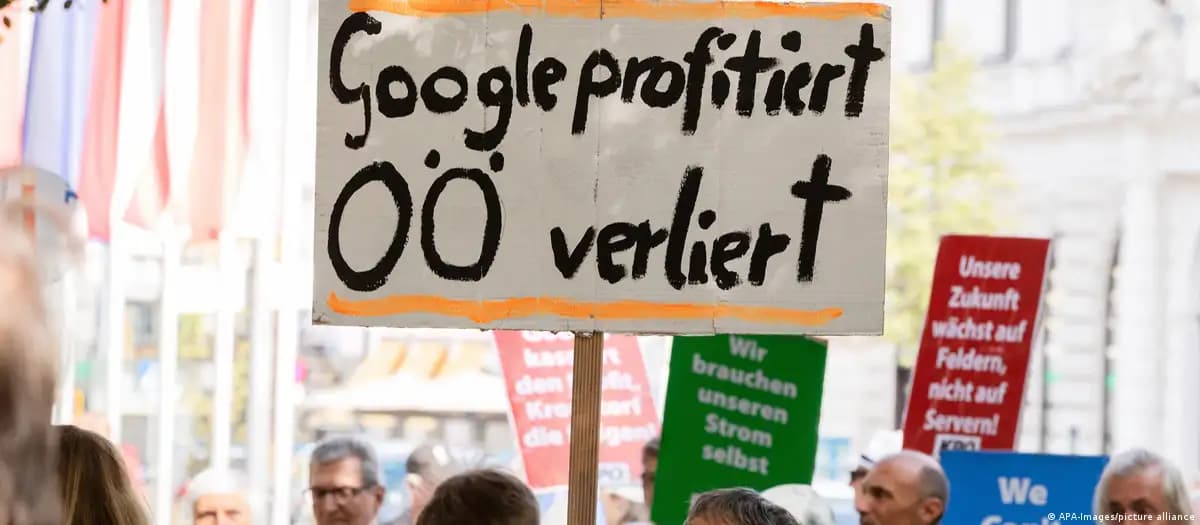
In Kronstorf, Austria, a town of barely 3,500 people, Google is pressing ahead with its first self-built data centre in the country: a 42,000 m² campus on a 70-hectare site, with a first phase of 150 MW that could expand to 500 MW and an estimated annual consumption of up to 4.4 TWh at full build-out — nearly a third of all electricity demand in Upper Austria. More than 400 people demonstrated outside the regional government in Linz, and further local protests drew hundreds of residents concerned about the project's transparency, its draw on water from the River Enns — which could receive up to 5.8 million litres a day of water heated to 30°C — and the lack of firm agreements on reusing waste heat. Google has responded with specific commitments: replenishing more freshwater than the site consumes by 2030, and setting up a fund for the Enns river ecosystem with the local fisheries association.
In Ireland, author Sally Rooney backed a campaign that succeeded in halting a proposed data centre in the village of Killala. In France, Google's project in Étrechet — with a rated capacity of between 800 MW and 1.1 GW, comparable to a nuclear plant running at full output — triggered the resignation of the mayor, three deputy mayors and a councillor, unable to shift the course of a project in their own municipality.
The secrecy around some of these projects doesn't help. A 2026 journalistic investigation found that Microsoft and the tech industry's lobbying arm had secured EU provisions keeping certain environmental data about their European data centres confidential, feeding public distrust just as Brussels tries to push for more transparency.
The models trying to change the equation
A handful of projects show that computing capacity can be built without repeating the pattern of heavy consumption and opacity.
In Marseille, a large AI data centre is under construction next to a key internet exchange point, using a closed-loop water cooling system expected to cut cooling-related energy use by 30%. In Dublin, Frankfurt and Berlin, waste heat from servers is already being fed into local district heating networks, warming hundreds of homes. A 2026 survey by German energy firm Eon found that nearly three-quarters of people would welcome a data centre near their neighbourhood if its waste heat were put to this kind of use. The European Commission itself estimates that reusing just half the waste heat produced by Europe's data centres would be enough to cover the heating needs of 4 million European households.
In Stackbo, Sweden, and Dublin, Microsoft has installed high-performance energy storage systems that help absorb demand spikes and stabilise the grid during normal operation, whilst also acting as backup during power cuts. In Austria, the Kronstorf project itself includes a green roof fitted with solar panels and a pledge to be ready to export waste heat free of charge once a willing partner is found.
What this means closer to home
The huge, headline-grabbing numbers attached to data centres — terawatt-hours, gigawatts, millions of litres of water — can make household energy use feel almost irrelevant by comparison. It isn't. Europe's electricity grids are shared infrastructure, and every kilowatt-hour saved at home is one less that needs to come from an already strained system, whether that strain is caused by a heatwave, a new data centre down the road, or both at once.
The same logic driving the EU's new transparency rules for data centres — you can't manage what you don't measure — applies just as well at home. Smart plugs and energy monitors reveal which appliances are quietly driving up a bill; apps that track real-time consumption make it far easier to shift washing, charging or heating to cheaper, greener hours on the grid; and simple efficiency upgrades, from better insulation to smarter thermostats, mirror at a household scale the same waste-heat-recovery thinking now being rolled out in data centres in Dublin, Frankfurt and Berlin. None of this offsets a gigawatt-scale server farm on its own, but it's the same principle operating at a different scale: efficiency and transparency, rather than unchecked growth, as the way to make more digital infrastructure and more comfortable homes compatible with the limits of Europe's grids.
What's at stake
Europe needs this infrastructure if it wants to reduce its reliance on American cloud providers and keep pace in artificial intelligence, yet every new data centre competes for water and electricity with the people already living nearby, and there's no easy way round that. The regulatory response — mandatory consumption labelling, future minimum efficiency standards, pressure to reuse waste heat — is an attempt to stop that growth from automatically translating into more strain on grids and rivers. If the links between digital sovereignty and energy independence keep strengthening, some of the projects generating distrust today could, over time, become far easier for their host communities to live with.
Sources
Deutsche Welle (David Ehl) — original reporting on the cost of digital sovereignty in Europe
White & Case LLP — EU regulatory outlook for data centres, 2026
European Commission / Engadget — proposal on energy and water consumption labelling, 21 September 2026
EU News — details of the classification scheme and waste heat reuse targets
Android Headlines — EU electricity consumption projections (68 TWh in 2024, 114 TWh by 2030) and capacity growth
The Register / Grundfos report, "Scale and Secure: Powering Europe's Digital Sovereignty" — current and projected IT load
Cybernews — Frankfurt's electricity demand, confidentiality of environmental data, the Uithoorn case in the Netherlands
Euronews — protests in Kronstorf, Austria
Ground News / Die Presse / ORF — water and electricity figures for the Kronstorf project
Tom's Hardware / DatacenterDynamics — technical details of Google's Kronstorf site
Deloitte — global and European data centre consumption linked to AI growth

 Danie Latorre