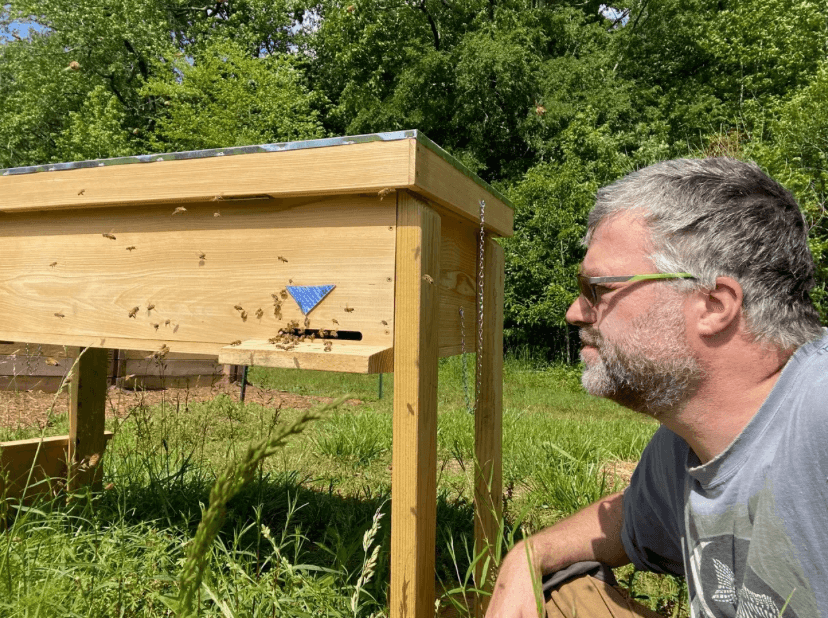
With a dog, cat or horse, the individual animal is the patient. With honey bees, the individual has little meaning outside the colony.
The health of a honey bee colony can depend on thousands of small decisions: whether there is enough food, whether parasites are spreading, whether pesticides are weakening the insects or whether a disease has gone unnoticed.
At the University of Georgia, veterinary students are learning how to make those decisions.
On a Sunday morning in April, Dr Jörg Mayer led a group of students into the university's teaching apiary. Wearing white protective suits and mesh hoods, they moved from hive to hive, opening the wooden boxes and examining the frames inside.
Their patients were not individual animals. They were colonies containing tens of thousands of bees.
That distinction is at the heart of honey bee medicine.
Honey bees are responsible for pollinating crops worth an estimated $15 billion a year in the United States, including more than 130 varieties of fruit, vegetables and nuts. Yet colonies face pressure from parasites, pathogens, pesticides, habitat loss, poor nutrition and a changing climate.
The losses have become difficult to ignore. In the 2024-25 season, more than half of the country's managed honey bee colonies were lost.
For commercial beekeepers, keeping colonies alive has become an ongoing struggle. “We're fighting a war to keep our bees alive,” said Bob Binnie, a beekeeper and owner of Blue Ridge Honey Company in Georgia.
Veterinarians are increasingly being asked to join that fight.
A missing piece of veterinary medicine
For Dr Mayer, the connection between veterinary medicine and beekeeping began long before he started teaching students about bees.
He grew up in a farming community in south-west Germany, surrounded by livestock. While studying veterinary medicine in Budapest, he became particularly interested in animals that received less attention in conventional veterinary training, including birds, reptiles and other exotic species.
Bees caught his attention too.
European veterinary schools were already more likely to include bee health in their curricula. Dr Mayer recalls bees being presented as something close to “micro-livestock”.
He began keeping hives himself after moving to the United States in the early 2000s. By then, one particular threat had become increasingly difficult for beekeepers to ignore: Varroa destructor, a parasitic mite that feeds on honey bees and can transmit disease.
Varroa is only part of the problem. Honey bee colonies can also be affected by viruses, fungi, bacteria, wax moths and hive beetles. Environmental stress can make colonies even less able to withstand those threats.
For decades, many American beekeepers handled these problems without veterinary help. They could often identify obvious problems themselves and, in some cases, obtain medicines without a prescription.
That changed in 2017, when federal rules restricted access to antibiotics because of concerns about antimicrobial resistance.
The new rules created an unexpected problem: beekeepers needed veterinarians, but many veterinarians had little experience with bees.
“In the United States, we weren't well prepared to care for honey bees,” said Dr Tracy S. Farone, a veterinarian at Grove City College in Pennsylvania.
She spent a year in Europe studying bee medicine and later became involved in efforts to expand veterinary education in the field.
Since 2017, professional organisations have developed courses and specialist training for practising veterinarians. Veterinary schools are beginning to introduce the subject to students as well.
A survey carried out in 2023 and 2024 found that 74 per cent of veterinarians were unsure how to prescribe medicines for honey bees, while 89 per cent said they could not identify diseases affecting them. For Meghan Milbrath, who runs a honey bee medicine programme at Michigan State University, the need for veterinary involvement is clear “The situation for bees and beekeepers is very difficult at the moment,” she said. “We really need everyone to work together.”
The patient is the colony
Treating bees requires veterinarians to rethink one of the basic ideas of their profession.
With a dog, cat or horse, the individual animal is the patient. With honey bees, the individual has little meaning outside the colony.
A worker bee may live only for a few weeks. The colony, however, can contain tens of thousands of individuals working together to regulate temperature, gather food, raise young and protect the hive.
Scientists therefore often describe a colony as a “superorganism”.
At Georgia, students learn to look at the hive as a whole.
The university's teaching apiary contains 13 colonies. Every week, members of the treatment team inspect the hives, beginning with the material that has fallen to the bottom.
Some debris is perfectly normal. Pollen and wax are signs of an active colony. Other discoveries can indicate trouble, including hive beetles, dead larvae or clusters of Varroa mites.
The students then examine the frames inside the boxes. They check food stores, brood development and available space, while looking for signs of pests and disease.
During the April inspection, two Varroa mites were found. That was not enough to justify treatment. The mites are now so widespread that finding a small number does not necessarily mean a colony is in danger.
The wider condition of the colony matters.
Lewis J. Bartlett, who leads research at the university's bee laboratory, explains that strong colonies can often cope with a certain level of parasites and pathogens. Nutrition and environmental conditions can make the difference.
A colony deprived of good forage, exposed to pesticides and weakened by other forms of environmental stress becomes much more vulnerable.
That is why the Georgia programme teaches students to look beyond individual diseases.

A veterinarian visiting an apiary should understand the conditions surrounding the colony, not simply identify a problem and prescribe a treatment.
“If you're called out to an apiary,” Dr Mayer said, “you don't want to be that person who simply arrives in a truck, writes a prescription and says, ‘See you later.’”
Finding a new generation
For some students, the programme has also changed the way they think about bees.
Madison Morgan, a fourth-year veterinary student from Austell, Georgia, arrived at veterinary school with no particular interest in them. Then she joined the university's bee club.
What began as curiosity developed into something much more serious. Morgan eventually became one of the leaders of the hive treatment team. She describes watching bees return to their colonies carrying large loads of pollen as unexpectedly satisfying. “When we see them coming back with those pollen trousers, we feel so proud of that bee,” she said.
That may be precisely the kind of outcome Dr Mayer is looking for. We need more professionals who understand enough about honey bees to recognise problems, advise beekeepers and know when a colony requires treatment.

For Dr Mayer, the relationship between bees and veterinary medicine has also extended into his work with other species. He has used honey to support wound healing in injured tortoises and armadillos and is investigating whether other bee products could have applications in treating animals with cancer.



 David Price
 Danie Latorre