Keeping your home warm is one thing. Getting enough fresh air without losing as much warmth is another.
That's where heat recovery ventilation also known as MVHR (Mechanical ventilation with heat recovery) comes in. It removes stale, moist air and uses its warmth to heat the fresh air coming into your home.
In fact, MVHR systems typically recover 80–90% of the heat from outgoing air. That means less heat is wasted through ventilation, although it doesn't mean your heating bills will fall by the same percentage.
But is it worth the installation cost, and how much could you actually save?
Let's look at how it works, what it costs in the UK, and whether it's a sensible investment for your home.
What Is a Heat Recovery Ventilation System?
A Heat Recovery Ventilation system brings fresh air into a building while removing stale air.
Unlike ordinary extractor fans, which send warm air straight outside, MVHR uses a heat exchanger to recover some of that warmth and pass it to the incoming fresh air.
This helps your home stay comfortable while providing the fresh air needed to reduce moisture and indoor pollutants.
A typical whole-house system removes damp air from kitchens and bathrooms and supplies filtered fresh air to living rooms and bedrooms. This controlled ventilation process is particularly useful in well-insulated, airtight homes where you want fresh air without unnecessary heat loss.
HRV, MVHR and ERV: What's the Difference?
You might come across these three terms when researching ventilation systems. They sound different, but they're closely related.
HRV (Heat Recovery Ventilation): Recovers warmth from outgoing air and transfers it to incoming fresh air.
MVHR (Mechanical Ventilation with Heat Recovery): Uses fans to move air through the system. HRV and MVHR generally refer to the same type of ventilation in UK homes.
ERV (Energy Recovery Ventilation): Works similarly, but transfers both heat and some moisture between the two air streams. This can help manage humidity, depending on the conditions.
For UK homeowners, MVHR is the term you'll most often see when looking at whole-house ventilation systems. What's more important is choosing a system that suits your home's ventilation needs.
How Does MVHR Work? Step by Step Explained
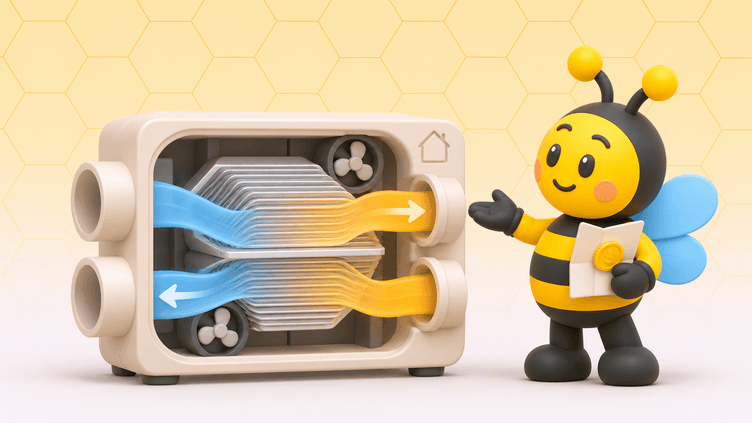
A heat recovery ventilation system (MVHR) uses two fans and a heat exchanger. One fan removes stale air and the other brings in fresh air. The exchanger passes heat from the outgoing air to the incoming air.
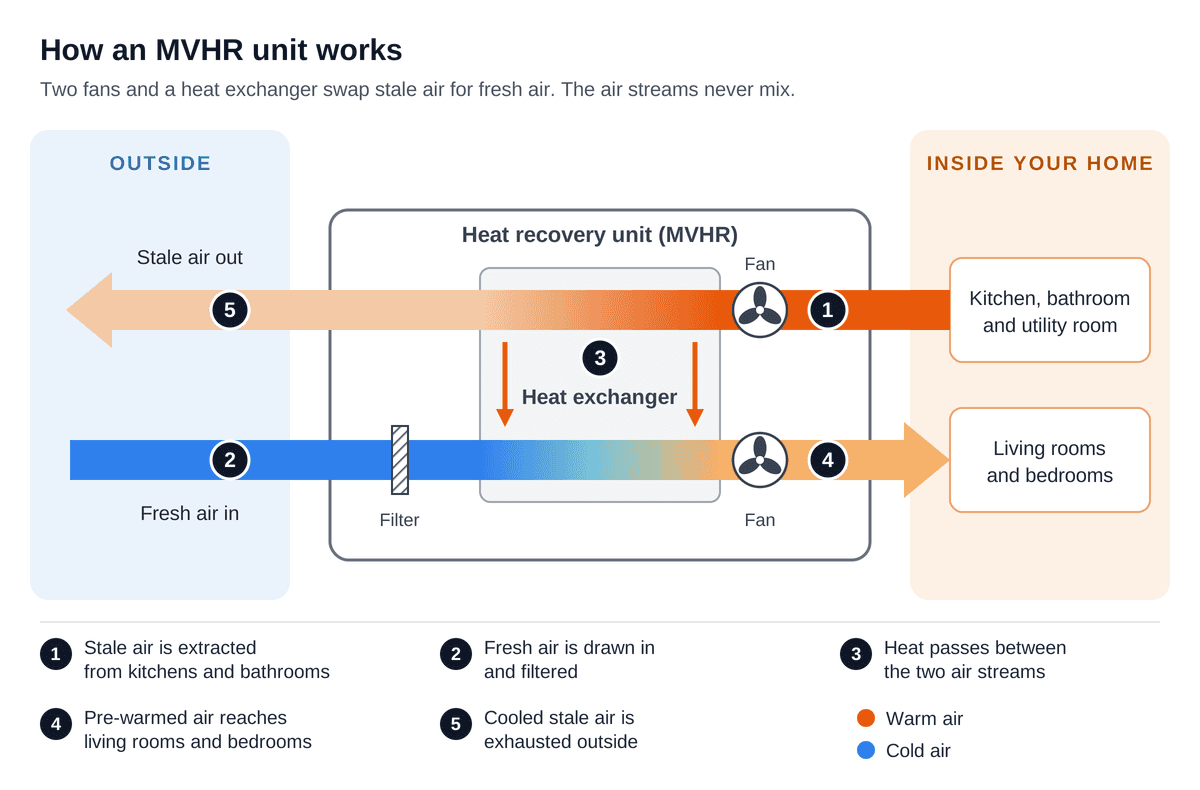
Step 1: Stale air is extracted from kitchens and bathrooms
Warm, moist air from cooking, showering and everyday activities is drawn out through vents in your kitchen, bathroom and utility room. It then travels through ducts towards the heat recovery unit.
Removing this moisture helps reduce condensation and mould growth in your home.
Step 2: Fresh outdoor air is drawn in and filtered
At the same time, another fan pulls fresh air in from outside. It passes through filters that catch fine particles before the air reaches your living spaces.
This provides a filtered supply of fresh air throughout your home.
Step 3: Heat transfers between the two air streams
Both air streams pass through a heat exchanger, separated by thin walls. Warmth from the outgoing air passes through these walls and heats the incoming fresh air.
The two air streams never mix. Only heat passes across, as the Passivhaus Trust explains.
The system recovers part of the heat, not all of it. We'll look at real-world figures in the savings section below.
Step 4: Pre-warmed air reaches living rooms and bedrooms
The fresh, filtered air travels through ducts into your living rooms and bedrooms, providing a continuous supply of fresh air.
The air arrives warmer than it was outside, so you get fresh air without as much of the chill. It isn't heating the room. It just takes the edge off the cold.
Step 5: Stale air is exhausted outside
After giving up some of its warmth, the outgoing air is released outside through a separate vent.
This cycle runs continuously, so your home keeps getting fresh air and loses less heat through ventilation than it would without heat recovery.
What Do Boost Mode and Summer Bypass Do?
Most MVHR systems run quietly at a low speed throughout the day. But they also have settings to help when your home needs more fresh air or feels too warm.
Boost mode: Makes the fans run faster to clear extra moisture and smells from cooking, showering or drying clothes. Some systems turn on automatically when the air gets too humid.
Summer bypass: Helps keep your home comfortable in warmer weather. When it's cooler outside than inside, fresh air can bypass the heat exchanger, so it comes in without picking up extra warmth.
Keep in mind: Summer bypass isn't air conditioning. It can bring in cooler outdoor air, but it doesn't actively cool the air itself.
How Much Does a Heat Recovery Ventilation System Cost in the UK?
A heat recovery ventilation system typically costs between £3,500 and £12,000 to install in the UK. The final price depends on your home's size, the system you choose and how much work is needed to fit the ductwork.
Installation is usually easier in a new-build home. Retrofitting an existing property can cost more, especially if walls, floors or ceilings need to be opened up.
Installation Costs by Home Size
Larger homes generally need more ductwork, air vents and a bigger ventilation unit. That can push up the price.
Here are the estimated UK heat recovery ventilation installation costs for different property sizes.
Property type | Estimated installation cost |
1 to 2 bedroom flat | £3,500 to £5,000 |
3 to 4 bedroom semi-detached house | £5,000 to £8,000 |
4 to 5+ bedroom detached house | £8,000 to £12,000 |
Before accepting a quote, check whether it includes the ventilation unit, ductwork, labour, system design, airflow testing and VAT.
Extra Costs for Retrofitting Existing Homes
Already living in your home? Installing MVHR may involve more work than you expect.
A retrofit often costs £8,000 or more, and Croydon Council's retrofit guidance puts the cost above £10,000.
The ventilation ducts need to reach several rooms. In a finished house, that could mean lifting floors, opening ceilings or building covers around exposed ducts.
You may also need to pay for plastering and decorating afterwards.
That's why planning ventilation alongside a major home renovation often makes more sense than installing it separately.
Tip: Ask your installer for an itemised quote. Make sure any repair and decorating work is included, so you don't face unexpected costs later.
VAT and Available Funding
Before budgeting, it's worth checking how VAT applies.
Unlike some renewable heating technologies, MVHR isn't included in the list of materials eligible for special VAT relief under HMRC's energy-saving materials guidance.
So check which VAT rate your quote uses. Different rules may apply when the system is installed as part of a qualifying new-build project.
As for grants, we found no grant for standalone MVHR installations in England (checked 20 November 2026).
However, some households may qualify for wider home energy improvements. The Warm Homes: Local Grant supports eligible households in England with improvements such as insulation, heating and solar panels.
MVHR isn't listed as a standard funded measure, so ask your local council what it can cover before making plans.
How Much Electricity Does It Use?
MVHR running costs come from the fans, which normally run all the time. Although they use relatively little power, that electricity adds up over a year.
For example, a system averaging 20 to 40 watts would have the following costs:
Average power use | Daily electricity use | Annual electricity use | Estimated annual cost |
20 watts | 0.48 kWh | 175.2 kWh | £46 |
40 watts | 0.96 kWh | 350.4 kWh | £92 |
Calculated using the 26.32p per kWh average electricity rate for October to December 2026, assuming the same rate for 365 days.
Note: These are examples, not guaranteed running costs. The temporary 0% VAT on electricity ends on 31 March 2027, and electricity prices may change. So the full-year estimates could be slightly low.
Remember, this is only the electricity cost of running the fans. Any heating savings from recovered warmth need to be calculated separately.
Filter Replacement and Servicing Costs
Like any ventilation system, MVHR needs regular maintenance to keep the air flowing properly.
The good news is that you can usually replace the filters yourself.
Typical MVHR maintenance costs include:
Replacement filters: Around £20 to £120 per pair, depending on the system.
Professional servicing: Around £150 for a basic service, with more detailed professional servicing starting at approximately £300.
Filters may need replacing every 3 to 12 months, depending on the unit and outdoor air quality. Follow your manufacturer's schedule rather than waiting until the filters become badly clogged.
You won't necessarily need professional service every year. However, the Passivhaus Trust's maintenance guidance recommends a more detailed professional service every four to five years. Some manufacturers require more frequent servicing, particularly for warranty cover.
Before buying: Ask how much replacement filters cost, how often they need changing and whether they're easy to find. A cheaper unit isn't always cheaper to maintain over several years.
How Much Could You Save on Heating Bills?
On heating bills alone, MVHR often saves very little. It recovers warmth that would otherwise escape, but fan electricity and maintenance costs can eat into those savings.
What Independent Research Says About Savings
A government-funded retrofit study measured 5% less heat loss, with a 7% margin of error. That meant no measurable improvement.
The installation also made the house leakier, while energy models predicted higher bills.
The report's model suggested a more airtight home might see its heating demand fall, though running costs might not.
How Much Is the Recovered Heat Worth?
For a typical three-bedroom home, our illustrative estimate uses 70 to 80% heat recovery in use and the October to December 2026 average gas rate of 7.97p per kWh.
Here's how the estimated annual savings compare:
Cost or saving | Annual estimate |
Value of recovered heat | £116 to £166 |
Fan electricity | £46 to £92 |
Saving after fan electricity | Around £25 to £120 |
Filters (£20 to £120 per pair) and professional servicing (from about £150) come on top.
Even the cheapest £3,500 system would take around 29 years to pay for itself at the best estimated annual saving of £120, before maintenance costs.
These are illustrative figures, not guaranteed savings for your home.
Why Advertised Savings May Differ
Some suppliers claim savings of up to 30% of space heating demand, but only in a relatively airtight building.
A 2013 NHBC Foundation study of 10 homes reported around 90% heat recovery in laboratory tests, compared with approximately 76% after an adjustment for real-world use. In one home, efficiency fell below 70% when the loft temperature dropped below 10°C.
It's a small, older study, but it shows how installation conditions can affect performance.
And remember, recovering 90% of ventilation heat doesn't mean cutting your heating bill by 90%.
The takeaway: MVHR may be more valuable for air quality and condensation control than financial savings. How well it works depends on your home, the installation and how you use it.
What Are the Pros and Cons of a Heat Recovery Ventilation System?
The biggest advantage of MVHR is getting fresh air into your home without losing as much warmth. It can also help reduce condensation and improve indoor air quality.
But there are drawbacks. Installation can be expensive, and the system works best when your home is properly sealed against draughts.
Here's a quick comparison:
Benefits | Drawbacks |
Fresh, filtered air: Continuously replaces stale indoor air and helps remove airborne pollutants. | Regular maintenance: Filters need replacing, and the system needs occasional servicing. |
Less heat wasted: Recovers some warmth from outgoing air instead of sending it all outside. | Electricity costs: Fans run continuously, which can offset heating savings. |
Less condensation: Removes moist air from kitchens and bathrooms, helping reduce the risk of mould. | Doesn't fix all damp problems: Water leaks and structural damp need separate repairs. |
Better comfort: Supplies pre-warmed fresh air, reducing cold draughts from ventilation. | High installation cost: Whole-house systems typically cost thousands of pounds. |
Controlled ventilation: Provides fresh air without relying entirely on opening windows. | Difficult retrofitting: Ductwork needs space, and older homes may need airtightness improvements. |
One thing worth remembering: MVHR works best in a well-sealed home. If your house is draughty, improving its airtightness may be a better first step.
Is Heat Recovery Worth Installing in Your Home?
On heating bills alone, MVHR rarely pays for itself quickly. Its main benefits are better indoor air quality and condensation control.
It's worth considering for well-insulated, airtight homes, especially new-builds and properties undergoing major renovations.
Why Home Airtightness Matters
Airtightness simply means how well your home prevents unwanted air from entering through gaps around windows, doors, floors and walls.
If your house is draughty, warm air can still escape through these gaps, even with MVHR running. That reduces the benefit of recovering heat through ventilation.
An airtightness test measures how leaky your home is. A smoke pen or thermal imaging can help find where the air gets in.
But sealing draughts doesn't mean stopping ventilation. Your home still needs a reliable supply of fresh air, particularly as it becomes more airtight. That's why airtightness and ventilation need to be considered together.
Under Approved Document F (England, 2021), the standard natural ventilation approach is intended for less airtight homes. That means an air leakage rate above:
5 m³/(h·m²) at 50 Pa in the design, or
3 m³/(h·m²) at 50 Pa when built.
A lower number means a more airtight home. Tighter properties need a suitable ventilation strategy, usually mechanical ventilation. MVHR is one option, but it isn't compulsory.
Which UK Homes Benefit Most?
Not every property needs a whole-house heat recovery system. Here's a quick guide.
Home type | Is MVHR worth considering? |
Airtight new-build | Yes. Ductwork is easier to plan during construction. MVHR is one option, while simpler extract-only systems cost less. |
Well-insulated modern home | Often worth considering if the property is airtight and has space for ductwork. |
Older home undergoing major renovation | Worth considering if you're improving airtightness and can install ducts during the work. |
Older, draughty property | Usually not the first priority. Address unwanted air leaks and assess ventilation needs first. |
Flat or home with limited space | Single-room heat recovery units may be easier to install than a whole-house system. |
It's worth planning home energy improvements together, because ventilation becomes more important as your home gets more airtight.
What to Check Before Installation: Sizing, Balancing and Commissioning
Even a good-quality system can perform poorly if it isn't installed correctly.
In a UK study of 54 MVHR homes, only 6 of the 38 homes with commissioning records (16%) had enough evidence to show that airflow and balancing had been completed satisfactorily.
That doesn't prove the other systems failed, but it shows why proper testing matters.
Before hiring an installer, check these three things:
Sizing: Is the unit suitable for your home's size and the amount of fresh air each room needs?
Balancing: Will the installer adjust the airflow so each room gets the right amount of air?
Commissioning: Will they test the finished system and give you a report showing the measured airflow?
Approved Document F (England, 2021) requires mechanical ventilation to be commissioned, meaning tested and adjusted. A commissioning notice must also be sent to building control.
Also ask about fan noise, ductwork, filter access and who will check for air leaks after installation.
Before spending thousands: Get your home's airtightness assessed and ask for a proper ventilation design. If you're retrofitting, make sure someone checks the airtightness again after the ducts are installed.
Whole-House vs Single-Room Heat Recovery: Which Is Better?
Whole-house systems are better suited to airtight homes needing ventilation throughout. Single-room units are usually cheaper and easier to install, especially in existing homes.
Whole-House Ventilation Systems
A central unit removes stale air from kitchens and bathrooms and supplies fresh, pre-warmed air to living areas and bedrooms.
It's ideal for new-builds and major renovations. However, fitting ductwork in existing homes can be costly and disruptive.
Single-Room Heat Recovery Units
These smaller units fit through an external wall and recover heat without extensive ductwork.
They're useful for ventilating individual rooms. Some work in pairs to balance incoming and outgoing air. You may need several units to ventilate an entire home.
Here’s a quick comparison table:
Feature | Whole-house MVHR | Single-room units |
Coverage | Entire home | Individual rooms |
Installation | Central unit and ductwork | Through external walls |
Cost | Higher upfront cost | Usually cheaper per unit |
Best for | New-builds and major renovations | Existing homes and individual rooms |
Main drawback | Disruptive to retrofit | Multiple units may be needed |
Which should you choose? Whole-house MVHR makes more sense when building or renovating an airtight home. For one or two rooms, single-room units may be more practical. If you only have a damp bathroom, a suitable extractor fan might be enough.
How to Maintain an MVHR System
Keeping your MVHR system working properly is fairly simple. Most routine maintenance involves replacing filters, cleaning vents and checking for unusual noises or reduced airflow.
Cleaning and Replacing Filters
Dirty filters can restrict airflow, make fans work harder and reduce the system's performance.
The Passivhaus Trust recommends replacing filters typically every 3 to 6 months, depending on outdoor air quality.
To keep your system running smoothly:
Replace filters following your manufacturer's instructions.
Clean air vents when dust builds up, without changing their settings.
Check warning lights or filter replacement reminders.
Arrange professional servicing as recommended for your system.
Only clean and reuse filters if the manufacturer says they're washable.
Common MVHR Problems and How to Fix Them
Most minor problems are easy to check before calling an installer.
Problem | What you can do |
Weak airflow | Check for dirty filters or blocked vents. |
Unusual fan noise | Check filters and fan-speed settings. |
Condensation returning | Check that the system is running and boost mode works. |
Cold air coming through vents | Check the settings and whether summer bypass is active. |
Warning light or error message | Follow the user manual or contact your installer. |
When should you call an installer?
If you've checked the filters and settings but the problem continues, contact your installer or a qualified ventilation engineer.
Get professional help if:
Airflow remains weak or condensation keeps returning.
You hear loud rattling, grinding or unusual fan noises.
Water leaks from the unit or ductwork.
Error messages keep appearing or boost mode stops working.
Don't attempt electrical repairs or adjust the system's airflow balancing yourself.
Remember: MVHR normally needs to run continuously. However, if you notice smoke or a burning smell, switch it off if safe and seek urgent professional help.
Frequently Asked Questions
Can Heat Recovery Ventilation Replace Central Heating?
No. MVHR recovers some warmth from outgoing air, but it doesn't generate enough heat to replace your boiler, radiators or heat pump. You'll still need a heating system to keep your home warm.
Does an MVHR System Need to Run All the Time?
Yes. Most systems are designed to run continuously at a low speed. Switching them off can allow moisture and stale air to build up. Use boost mode when cooking or showering instead.
Can You Still Open Windows?
Yes, you can open your windows whenever you like. Just remember that opening them in winter lets some warmth escape. In summer, opening windows when it's cooler outside can help cool your home.
Does It Help Prevent Condensation and Mould?
Yes, MVHR can help reduce condensation by removing moist air from kitchens and bathrooms. However, it won't fix mould caused by water leaks or structural damp. Those problems need separate repairs.
Can MVHR Work Alongside a Heat Pump?
Yes. A heat pump heats your home, while MVHR provides fresh air and recovers warmth. They can work together without replacing each other. Some exhaust air heat pumps combine ventilation and heating in one system.
Can It Improve Your EPC Rating?
Potentially, but it's not guaranteed. The updated RdSAP 10 assessment method takes mechanical ventilation into account. Whether your rating improves depends on your home's overall energy performance and the system installed. Keep your installation documents for the EPC assessor.

 Sharieaz Kavier