
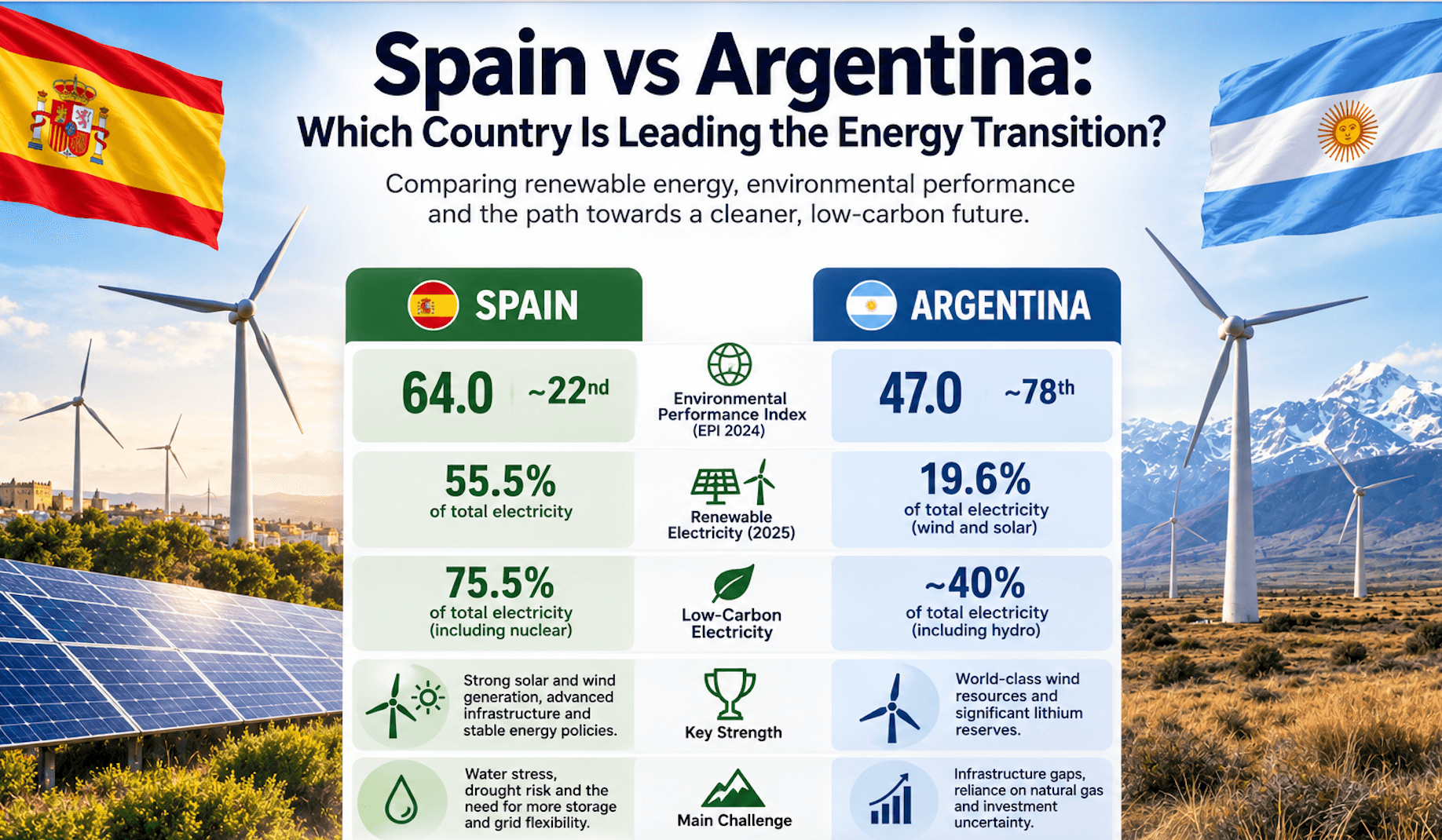
Spain and Argentina are pursuing very different paths towards a cleaner energy future.
Spain has become one of Europe's renewable energy leaders, rapidly expanding solar and wind generation while reducing its dependence on fossil fuels. Argentina, meanwhile, is harnessing some of the world's strongest wind resources and developing strategic minerals that will help power the global transition to clean energy.
So which country is ahead?
To answer that question, we compared environmental performance, electricity generation, renewable energy deployment, and long-term energy strategy. The result is a fascinating snapshot of two nations approaching the same challenge from very different starting points.
Environmental Performance Comparison
One of the most widely used tools for measuring environmental performance is the Environmental Performance Index (EPI), developed by researchers at Yale and Columbia Universities.
The index assesses 58 indicators across 180 countries, covering areas such as air quality, climate policy, biodiversity, water management, waste treatment, and greenhouse gas emissions.
Environmental Performance Index (2024)
Indicator | Spain | Argentina |
|---|---|---|
EPI Score | 64.0 | 47.0 |
Global Ranking | ~22nd | ~78th |
Overall Performance | Strong | Moderate |
Spain currently ranks among the world's strongest environmental performers. Long-term climate policies, renewable energy investment, and European Union environmental regulations have all contributed to its position.
Argentina sits lower in the rankings but remains ahead of many countries with larger industrial footprints. Its environmental performance reflects both its abundant natural resources and the challenges associated with infrastructure development, economic volatility, and long-term policy consistency.
At present, Spain holds a clear advantage on overall environmental performance.
Renewable Electricity Generation in Spain and Argentina
Electricity generation provides one of the clearest indicators of how far a country has progressed in its energy transition.
This is where the comparison becomes particularly interesting.
Spain's Renewable Energy Mix
Spain ended 2025 with renewable energy supplying 55.5% of total electricity generation.
When rooftop solar self-consumption is included, renewable electricity rises to approximately 56.6%.
Solar photovoltaic generation contributed around 18.4% of the country's electricity, while wind power remained one of the largest contributors to the national grid.
When nuclear energy is included alongside renewables, approximately 75.5% of Spain's electricity came from low-carbon sources.
Perhaps most impressive is the decline of coal. Once a major pillar of Spain's electricity system, coal now accounts for only a small fraction of generation.
The result is one of Europe's cleanest large-scale electricity systems.
Argentina's Renewable Energy Mix
Argentina's electricity transition is at an earlier stage, but momentum is building rapidly.
During 2025, wind and solar energy supplied approximately 19.6% of national electricity demand — a record for the country.
When hydroelectric generation is added, low-carbon electricity accounted for roughly 40% of total generation.
Much of this growth has been driven by Patagonia, whose wind resources are widely considered among the strongest and most consistent in the world.
Several months during 2025 saw renewable energy achieve record participation levels, exceeding 50% of monthly generation on certain occasions.
Natural gas remains the dominant source of electricity, however, supplying more than half of total generation.
Electricity Scoreboard
Category | Spain | Argentina |
|---|---|---|
Renewable Electricity | 55.5% | 19.6% (wind and solar) |
Low-Carbon Electricity* | 75.5% | ~40% |
Largest Renewable Source | Wind & Solar | Wind |
Dependence on Natural Gas | Moderate | High |
Dependence on Coal | Very Low | Very Low |
*Including nuclear generation in Spain and hydroelectric generation in both countries.
Spain's Energy Transition Strategy
Spain's success is built on a combination of geography, infrastructure, and long-term policy.
Excellent solar resources, favourable wind conditions, modern grid infrastructure, and stable regulatory frameworks have helped accelerate renewable energy deployment over the last decade.
The country is now entering the next phase of the energy transition.
Large-scale investments in green hydrogen aim to decarbonise sectors that are difficult to electrify directly, including heavy industry, chemicals, shipping, and parts of the transport sector.
Projects such as the Andalusian Green Hydrogen Valley highlight Spain's ambition to become a major producer of renewable fuels while strengthening Europe's energy independence.
Spain's strategy is no longer simply about generating clean electricity. It is increasingly about building an entire low-carbon industrial ecosystem.
Argentina's Renewable Energy Potential
Argentina's greatest advantage lies in its natural resources.
Patagonia possesses some of the strongest onshore wind resources on Earth, offering exceptional conditions for utility-scale wind generation.
At the same time, Argentina is one of the world's leading lithium-producing nations. Lithium plays a critical role in battery manufacturing, energy storage systems, and electric vehicles.
These resources position Argentina as an important player in the global energy transition.
The challenge is transforming that potential into long-term infrastructure, grid expansion, industrial capacity, and sustained investment.
If those conditions can be achieved, Argentina has the opportunity to become one of the most important renewable energy markets in South America.
What Can Each Country Learn From The Other?
Comparisons are most valuable when they reveal opportunities.
What Can Spain Learn From Argentina?
The strategic importance of critical minerals such as lithium.
How large-scale natural resources can support future energy industries.
The value of long-term resource planning for energy security.
What Can Argentina Learn From Spain?
The benefits of regulatory stability for attracting investment.
The importance of grid infrastructure in supporting renewable growth.
How long-term energy policies can accelerate decarbonisation.
Both countries demonstrate that there is no single route towards a cleaner energy future.
Different starting points require different strategies.
Key Sustainability Challenges
Spain
Strengths
High renewable electricity generation.
Mature solar and wind sectors.
Strong climate policy framework.
Integration with European energy markets.
Challenges
Increasing water stress.
Drought-related risks.
Growing need for energy storage and grid flexibility.
Argentina
Strengths
World-class wind resources.
Significant lithium reserves.
Vast renewable energy growth potential.
Low dependence on coal.
Challenges
Transmission infrastructure constraints.
Continued reliance on natural gas.
Investment uncertainty.
Economic volatility.
Frequently Asked Questions
Is Spain more sustainable than Argentina?
According to the 2024 Environmental Performance Index, Spain currently ranks significantly higher than Argentina due to stronger environmental performance across multiple indicators, including climate policy, air quality, and renewable energy deployment.
Does Argentina produce renewable electricity?
Yes. Argentina recorded its highest-ever levels of wind and solar generation in 2025, with renewable energy continuing to increase its share of the national electricity mix.
Why is Spain considered a renewable energy leader?
Spain benefits from excellent solar and wind resources, strong infrastructure, long-term policy support, and substantial investment in renewable technologies.
Does Argentina have significant renewable energy potential?
Absolutely. Patagonia's wind resources are among the strongest globally, while Argentina's lithium reserves position the country as an important supplier for battery and energy storage technologies.
Which country is further ahead in the energy transition?
At present, Spain is further ahead in terms of renewable deployment, low-carbon electricity generation, and environmental performance. Argentina, however, possesses enormous long-term growth potential thanks to its natural resources and expanding renewable sector.
Final Verdict
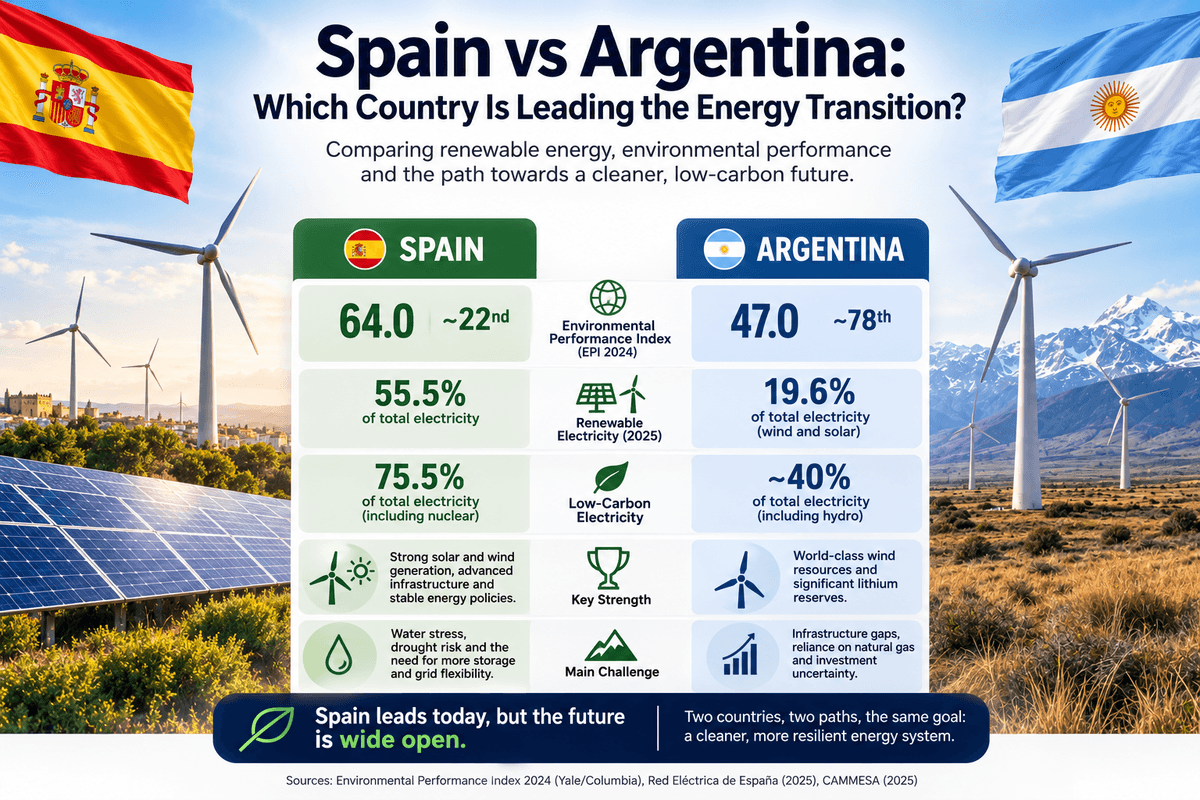
Today, Spain leads the scoreboard.
Its electricity system is cleaner, its renewable energy sector is more mature, and its environmental performance is stronger across a wide range of indicators.
Still, Argentina demonstrates the scale of opportunity that still exists in the global energy transition. Few countries possess such exceptional wind resources alongside strategic minerals that are essential for electrification and energy storage.
Spain may be ahead today, but Argentina's potential suggests that the final table is far from settled.



 Danie Latorre