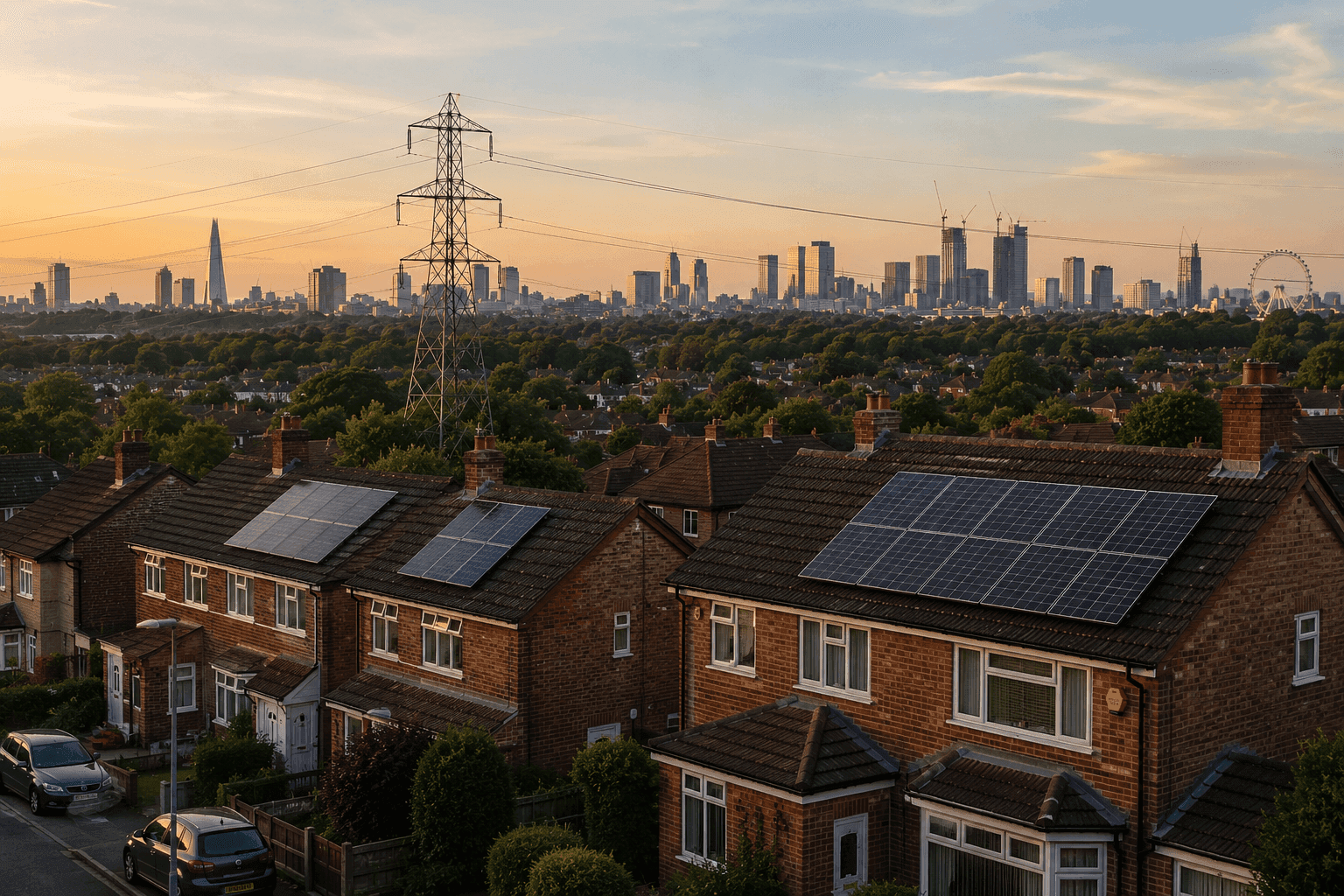
On the Tibetan Plateau, in Gonghe County, Qinghai Province, China has built the largest solar power plant on Earth. The Talatan Solar Park now holds that title outright, according to the New York Times and the Financial Times, and it isn't close: the site spans roughly 420 km² — about seven times the size of Manhattan — with plans to expand to 610 km², an area comparable to Singapore.
More than seven million solar panels, laid out across a high-altitude desert nearly 3,000 metres (10,000 feet) above sea level. The thin air and near-constant sunshine at that altitude give the panels a real performance edge: reduced cloud cover and moisture mean the site produces a notably higher annual energy yield than comparable solar infrastructure closer to sea level.
The numbers
Installed capacity: 21 GW as of March 2026, up from an earlier reported 16.9 GW, making it the largest solar plant in the world by both area and output.
Panels: over 7 million, with continued construction pushing that figure higher through 2026.
Annual generation: over 18,000 GWh (18 TWh), enough to power an estimated 5 to 6 million homes.
Altitude: close to 3,000 metres, in the semi-arid Gonghe Basin.
Developers: Powerchina Hebei Electric Power Engineering and Datang Qinghai Energy Development.
Transmission: high-voltage lines carry the power over 1,000 miles to distant cities.
Timeline: development began in 2011 in phases; the park is expected to keep growing over the next three years, potentially reaching ten times the size of Manhattan.
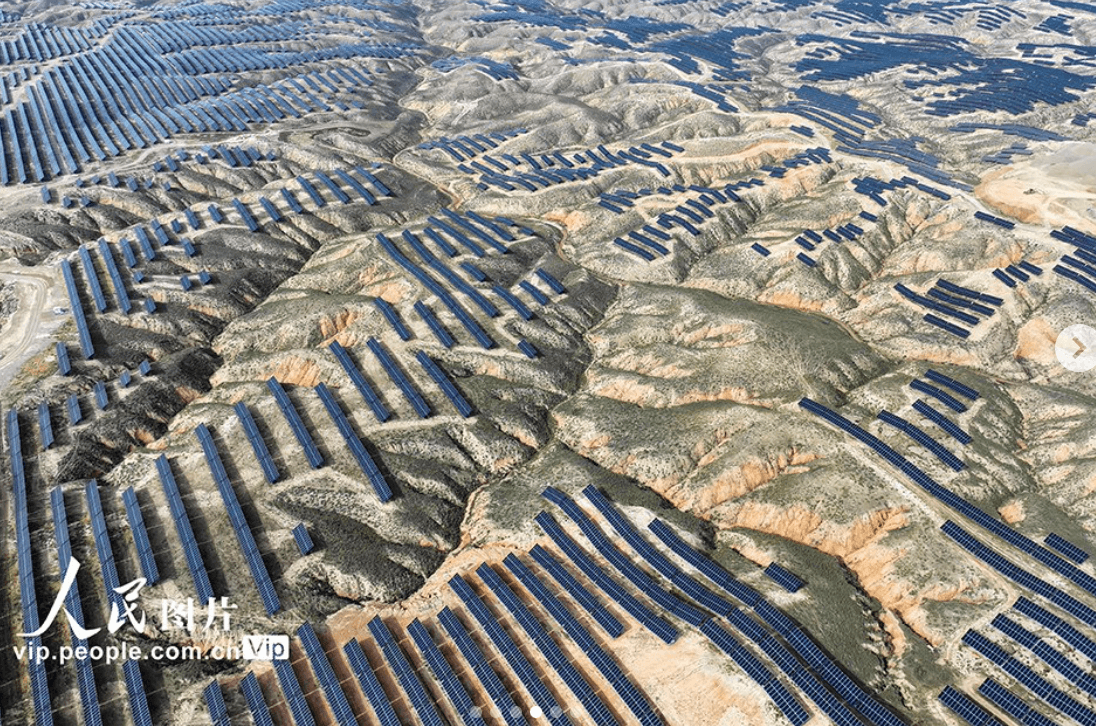
Talatan it's part of a bigger and wider energy complex. The plateau includes 4,700 MW of nearby wind power and 7,380 MW of hydroelectric capacity, including the Longyangxia Dam. The pairing is deliberate: engineers use pumped storage to send water uphill during the day, when solar output peaks, then release it at night to keep power flowing after the sun goes down. It's a system built to make an intermittent resource behave like a steady one.
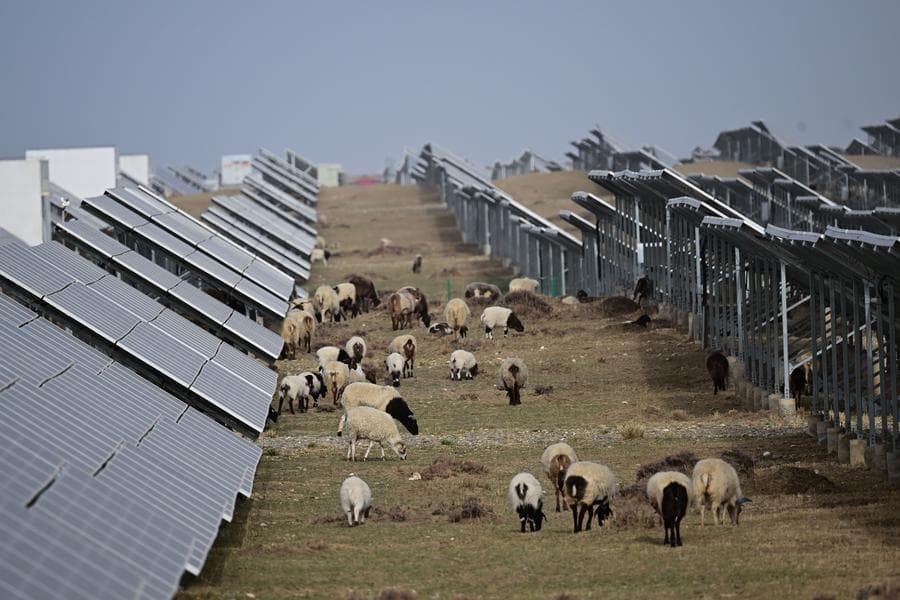
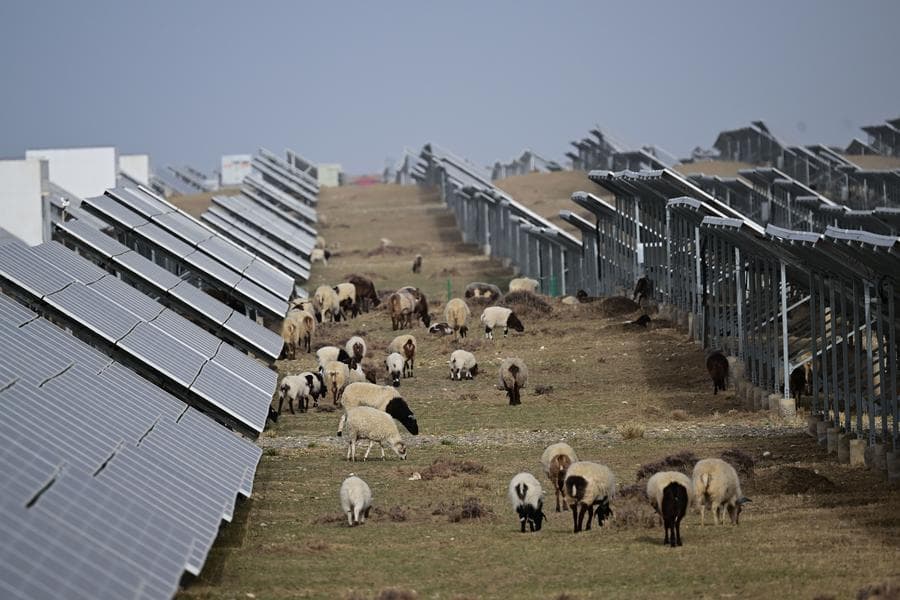
The project also has an unusual local footprint. Beneath the panels, flocks of sheep graze on the vegetation that grows in their shade, a role that's earned them the nickname "photovoltaic sheep" and even spawned a mutton brand tied to the park.
A desert chosen on purpose
High altitude means thinner air and stronger solar irradiation; low population density and extensive desertified land mean fewer competing land uses. China has replicated the formula elsewhere — the Gobi, Kubuqi in Inner Mongolia, Tengger in Ningxia, Gurbantünggüt in Xinjiang all host major solar developments — but none rivals Talatan's scale. China now operates 11 of the world's 15 largest solar farms, and Qinghai's plant leads that list by a wide margin.
The project is part of China's broader climate commitments: a pledge to cut greenhouse gas emissions, expand renewable output roughly sixfold in the coming years, and reach carbon neutrality by 2060. Officials have also linked the site to newer, more energy-hungry demands: corporate data centres and AI infrastructure draw directly on the low-cost power it generates, alongside electric vehicles and high-speed rail.
Is it sustainable?
As with many energy production projects, we need to take a closer look and remain cautious.
Generation itself is genuinely low-carbon, but the local ecological effects are still being studied, and there's an underlying debate about whether "sustainable" is even the right word for infrastructure at this scale.
The case in favour
Satellite research across China's desert solar sites shows panels produce a surface cooling effect ranging from 0.2°C to 3.1°C depending on the location, and the shade they cast reduces evaporation, creating milder, more humid microclimates that support plant recovery. At Talatan itself, the grazing sheep beneath the panels are part of a deliberate strategy: they keep vegetation under control whilst improving the soil. At the Gurbantünggüt site in Xinjiang, near-surface wind speeds dropped by 30–50%, helping to fix dunes that were previously semi-mobile.
Chinese authorities present these projects as an "ecology plus industry" model: generating electricity whilst tackling desertification, a problem the country has battled for decades.
According to an official China's Government website, local communities are happy and hopeful:
"Our village depends mainly on animal husbandry, and many families raise sheep. In the past, the grassland wasn't productive enough, so herders had to take their sheep far away to find grazing land". Yehdor, a local 49-year-old herder, now tends his flock while riding a motorcycle.
The reservations
Not everything is settled or straightforwardly positive. At nearby Talatan-region sites in Qinghai, researchers have found panels measurably altering soil and vegetation beneath them, in an ecosystem that's naturally cool and fragile. Water is a sharper concern still: a 2025 study on solar development in north-west China found that some desert regions — Ulan Buh, Badain Jaran and Qaidam among them — face significant water resource pressure, meaning solar development there needs careful planning to avoid ecological harm. Tengger and Kumtag, by comparison, showed better conditions with lower water conflict. And whilst operating panels uses little water, construction does — dust control requires it, and in arid regions that can strain local aquifers, a pattern also documented in comparable projects in the United States.
Taken together, the evidence suggests the environmental impact can be positive when sites are well chosen — already degraded soil, low water pressure — and can create new problems when local conditions are overlooked.
What is the environmental cost?
Beyond individual sites, there's a broader and less-discussed scientific debate: the aggregate climate effect of covering vast stretches of desert with dark panels.
A study published in Environmental Science & Technology modelled what would happen if solar panels covered 20% of the planet's desert surfaces. It found a 6.95% reduction in near-surface wind speed globally, driving a 5.5% fall in global wind power potential — around 312.47 TWh a year. The same study found the panels induce local atmospheric changes, including higher surface temperatures and more cloud cover, that would cut solar output by 22.44 TWh. The researchers describe this as a self-limiting effect: covering more desert surface with panels gradually erodes renewable potential both locally and in distant regions through climatic teleconnections.
Zhengyao Lu, a researcher in physical geography at Lund University, notes that panels convert only around 15% of the solar energy they receive into electricity; the rest returns to the environment as heat. Because panels are far darker than the sand they cover, they absorb more energy than the desert would naturally, and that extra energy is released as heat, capable of shifting local climate patterns once the scale is large enough — a dynamic directly relevant to a site the size of Talatan.
A study in Scientific Reports points to a further gap: quantitative evidence on the real ecological effects of large-scale photovoltaic development in deserts remains limited, with most existing work relying on qualitative assessment. That makes it harder to build a comprehensive, reliable evaluation framework for projects of this size.
What do climate experts say about these mega-projects?
Expert opinion splits between enthusiasm for the decarbonisation potential and warnings about physical limits and the narrative built around these projects.
Satellite and field studies across China's desert sites document genuine ecological restoration benefits and emissions savings, and Chinese authorities frame the programme as part of their strategy to curb desertification and dust storms. But the researchers behind the Environmental Science & Technology study stress the need for integrated global energy planning that accounts for climatic feedbacks across borders, instead of treating each mega-project as an isolated case.
There's scepticism about the narrative too. Analyst Ozzie Zehner, cited in an MERIP piece, questions the "sustainability spectacle" surrounding desert mega solar plants, arguing they're often presented as an unquestionably positive solution without much scrutiny of what the energy is actually used for or whether the demand driving it is sustainable in itself — a question with particular weight given how much of Talatan's output is earmarked for data centres and AI infrastructure. And on the technical side, researchers behind the 2025 study on north-west China argue the water-energy conflict needs frameworks such as their proposed "water-electricity-road" network, prioritising deserts with lower water pressure before the model expands into more fragile areas.
To resume
Talatan is now, by a wide margin, the largest solar power plant on the planet: 21 GW of capacity, over seven million panels, and a footprint still growing toward ten times the size of Manhattan. It stands as the clearest evidence yet that China's renewable ambitions have moved from planning into physical reality, and it's paired with wind and hydro infrastructure engineered to keep power flowing around the clock. Recent science tempers the enthusiasm, though: there's evidence that covering too much desert surface with panels can trigger climatic effects that feed back on each other — less wind, less wind power generation, higher local temperatures — and open questions remain about water pressure and soil transformation in fragile high-altitude ecosystems. The most honest conclusion the evidence supports is that the sustainability of a project like Talatan depends on site selection and scale, not on the simple fact of building in the desert.
Sources consulted
New York Times / Financial Times (via Wikipedia, Talatan Solar Park entry) — plant status and capacity data
Newsweek — panel count, capacity, homes powered
The Cool Down — plant scale and expansion plans
Colombia One — capacity figures and site description
Global Business Outlook — dual land use, "photovoltaic sheep"
Noticias Ambientales — capacity and emissions context
Wattlytics — capacity, generation figures, Longyangxia Dam pairing
Energies Media — panel count and expansion timeline
Global Energy Monitor / NASA Earth Observatory — China's broader solar capacity
CGTN — Gurbantünggüt project, Xinjiang
Renew Economy — satellite study on desert cooling effects
Environmental Science & Technology (ACS Publications) — self-limiting climatic effects of desert solar
Scientific Reports (Nature) — ecological assessment of desert photovoltaic projects
Environmental and Sustainability Indicators — water-energy conflict in north-west China
Trellis — interview with Zhengyao Lu (Lund University)
MERIP — Ozzie Zehner's critique of the desert solar "spectacle"
Inside Climate News — water impact of solar construction in arid regions (comparative case, US)