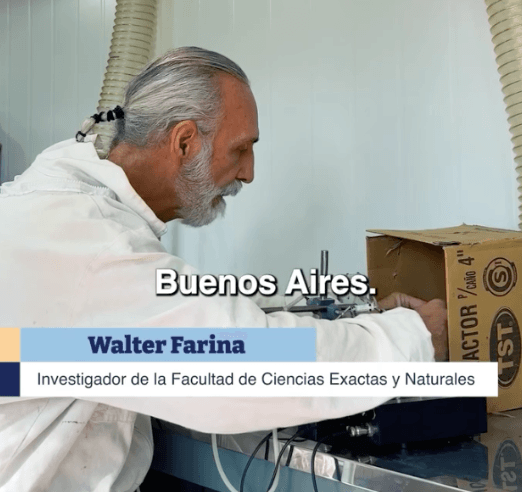
For fifteen years, a research group at the University of Buenos Aires has pursued a question with huge implications for farming: can a beekeeper steer an entire colony towards a chosen crop?
The answer, according to Walter Farina and his team at the Laboratory of Social Insects (IFIByNE, UBA/CONICET), lies in a clever exploitation of colony memory and communication.
Bees carry out roughly a third of global crop pollination, placing them at the heart of food production worldwide. A colony left to forage freely follows scent trails and floral cues wherever they lead, so growers often compete for pollinator attention against wild blooms, weeds, and neighbouring fields. Farina's team set out to redirect that attention towards the crops that matter most.
A Scent, a Reward, and a Waggle Dance
The method rests on associative learning. Researchers expose a portion of the hive to a synthetic fragrance that mimics the target crop's flower, paired with a sugar reward. Foraging bees learn the association quickly, then carry both the scent and the memory of the reward back to the hive. Through the waggle dance and pheromone signals colonies use to share information about food sources, that knowledge spreads through the whole population within days.
Farina explains the core process with a modern analogy: "colony communication works like a social network". Word of mouth, but built on scent and movement instead of screens. A handful of trained foragers become the seed of a message that ripples outward through hundreds, then thousands, of workers.
Watch the full video on Instagram: University of Buenos Aires (@uba_ar)
From Laboratory Insight to Field Results
Over fifteen years of research, Farina's group secured six patents for fragrances that boost pollination in sunflower, pear, apple, almond, blueberry, and kiwi crops. Fresh work continues on alfalfa, avocado, cherry, and strawberry. Field trials report yield increases ranging between twenty and ninety per cent, depending on the crop and growing conditions.
Patents already cover Argentina, the United States, and China, with applications proceeding through the European Union, Australia, and several Latin American countries. UBA and CONICET hold the underlying intellectual property, while a licensing arrangement channels the technology towards commercial use.
The company translating this science into a working service is Beeflow, founded in Argentina and now running offices in the United States, Peru, and Mexico. Beeflow coordinates with beekeepers and growers, timing colony deliveries to match each crop's flowering window and applying training technology in the weeks beforehand.
Why This Matters for the Future of Food
Pollinator populations face pressure worldwide from habitat loss, pesticide exposure, and disease. Directed pollination gives growers a practical route towards stronger yields, while offering beekeepers an additional value proposition beyond honey production. Blueberry flowers, for instance, produce thin nectar rewards, so bees tend to favour easier alternatives nearby. A synthetic fragrance paired with training makes a measurable difference to fruit set in exactly these tricky cases.
The approach also reveals something broader about insect cognition: colonies operate as distributed learning systems, capable of shifting their foraging priorities based on signals a small subgroup brings home. Harnessing that capacity, rather than working against it, opens a path towards agriculture built around natural behaviour rather than brute-force intervention.
Directed pollination looks set to become a standard tool in the modern grower's kit, sitting alongside irrigation scheduling and pest management as a lever for boosting harvest quality and volume.
The EnergieBee Take
Argentina's research shows what becomes possible when scientists study these systems closely enough to work with their logic, turning a biological curiosity into a genuine agricultural technology with global reach. A colony of bees, coordinating complex behaviour through simple local signals passed between thousands of individuals: a parallel to the kind of efficient, self-organising networks we love to learn from.