
At 1am on 6 July, millions of us stayed up to watch Jude Bellingham drag England through a bad-tempered Round of 16 tie at the Azteca Stadium — ten men for over 40 minutes after Jarell Quansah's red card, a Harry Kane penalty, and a 3-2 win that knocked the host nation out in front of their own fans.
Then the final whistle went. Somewhere across the National Grid, hundreds of thousands of kettles clicked on at once — and the World Cup 2026 electricity demand spike was already showing up in the data.
Key takeaways:
England's win over Mexico landed in one of the highest-demand windows of the tournament, a 1am kick-off
National Grid electricity demand regularly jumps 200–2,800 MW around big England matches
The 2026 World Cup is on track to be the greenest World Cup ever for UK TV viewing, and one of the most polluting World Cups on record overall — two different measurements, both true at once
What is the World Cup kettle surge?
The National Energy System Operator (NESO) tracks UK electricity demand around every major tournament, and it's one of the most charming bits of data Britain produces: the moment a match ends, demand on the grid jumps as the country heads to the fridge or puts the kettle on. Energy analysts plan for it, using forecasting and technologies like battery storage and pumped hydro to keep supply and demand balanced.
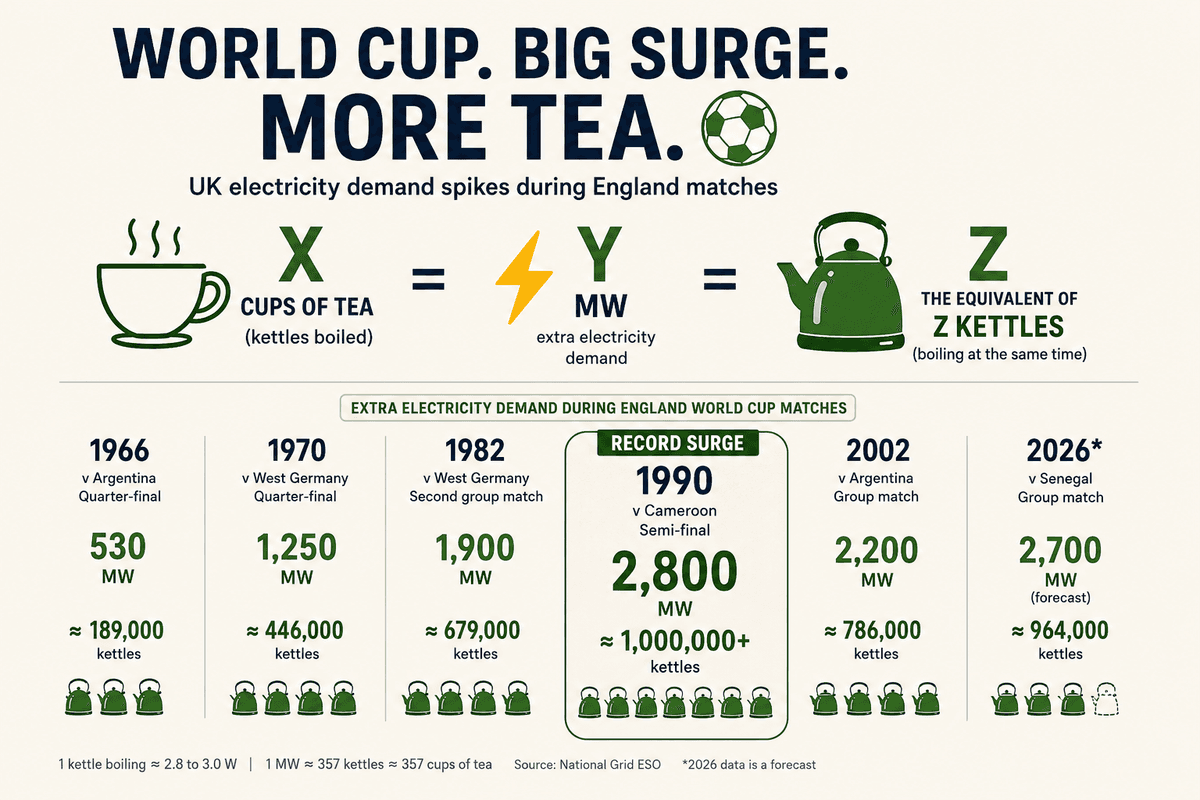
It's measurable, and the numbers have been climbing for decades:
1990 semi-final, England vs West Germany: a missed penalty triggered a 2,800 MW surge — still the record, equivalent to more than a million kettles switching on at once
2018, England vs Colombia: 1,400 MW after England's first-ever World Cup penalty shootout win
2022, England vs France (quarter-final): 914 MW at half-time
2024 Euros final, England vs Spain: 1,300 MW at half-time
2025 Women's Euros final: 400 MW at half-time, plus another 150 MW the moment Chloe Kelly scored the winning penalty
NESO's engineers flagged England's Croatia opener for World Cup 2026 as good for an 800 MW pickup, bigger than the 600 MW spike recorded during the 1966 final. Scotland's late-night group games were pencilled in for up to 200 MW each, landing in Britain's quietest hours for electricity use, which makes any spike stand out even more. An England knockout match in the small hours, decided with ten men on the pitch, is exactly the kind of fixture that tends to blow past the forecast.
Is the World Cup 2026 good or bad for energy use? Both, depending what you measure
NESO's own data makes a strong case that this is the greenest way Britain has ever watched a World Cup. Around 40–50% of the electricity used is expected to come from renewables, a huge shift from 1994, when TVs ran largely on coal. Thanks to more efficient TVs and devices, Britain is on track to use roughly 20% less electricity to watch matches than it did in 1998, the last time Scotland played in a World Cup, despite the population growing by 11 million since then.
That's the story of watching football at home. The tournament itself tells a different story.

Why the 2026 World Cup has the biggest carbon footprint in tournament history
This is the first 48-team World Cup, with 104 matches spread across 16 host cities in three countries — the United States, Canada and Mexico — separated by thousands of kilometres. Getting teams, media and fans between those cities means flying, at a scale the World Cup hasn't seen before.
Independent carbon accounting analysts put the tournament's footprint somewhere between 7.8 and 9 million tonnes of CO2, more than double the official figure for Qatar 2022, with worst-case scenarios reaching as high as 15 million tonnes. Air travel accounts for roughly 85% of that total. One analysis found that an England fan following the team to every match through to the final could rack up around 3.5 tonnes of CO2 in travel alone, from a single tournament.
This sits alongside NESO's numbers rather than against them. They're measuring different things: the electricity in your living room, and the flights getting 48 nations and their fans around three countries for six weeks.
Will the 2030 World Cup be even worse for carbon emissions?
The 2030 tournament will be hosted primarily across Spain, Portugal and Morocco, with three additional matches in Uruguay, Argentina and Paraguay to mark the World Cup's centenary, sending fans and teams across three continents. Sustainability researchers have already weighed in: Carbon Market Watch called the format "an unfortunate geographic choice," and a French sports-law academic described it as an "ecological aberration." Official emissions estimates for 2030 haven't been published yet, but the direction of travel, more teams, more matches, more distance, is clear.
How to cut your own energy use while watching the World Cup
Flight paths between Vancouver and Mexico City sit well outside anyone's control from a sofa in Leeds or Glasgow. The electricity used to watch the game is a different matter, especially at 1am, with the telly, the lights, three phones and a kettle all running at once. A few habits make a real difference:
Switch off standby devices before kick-off rather than leaving them idling all night
Watch on one screen instead of three or four across the house
Time the kettle for a natural pause in play rather than the exact final whistle, when the whole grid reaches for it too
Check your own home's energy use with a smart meter or smart plug, so match-night spikes are visible rather than hidden in the monthly bill
The World Cup's carbon bill gets settled well beyond the average British living room. Keeping your own home efficient is the part worth getting right.
FAQ
How much does England playing in the World Cup affect UK electricity demand?
England's biggest matches have triggered National Grid demand spikes of up to 2,800 MW, driven mainly by kettles, fridges and lights switching on at half-time and full-time.
Is the 2026 World Cup better or worse for the environment than previous tournaments?
Both. UK TV viewing is expected to be the cleanest on record, powered by 40–50% renewable electricity. The tournament overall is expected to be the most polluting World Cup ever staged, mainly due to flights across three host countries.
Why is the 2026 World Cup's carbon footprint so high?
The switch to 48 teams and 104 matches spread across 16 cities in the US, Canada and Mexico has driven a sharp rise in air travel, which accounts for around 85% of the tournament's estimated emissions.



 David Price
 Danie Latorre