
There's a small insect that's spent more than 150 years representing one of Britain's most industrious cities. In 2026, that same bee has become, almost by accident, the emblem of a much bigger argument: how Britain wants to build its energy future, and who should get the final say — Westminster, or the cities themselves.
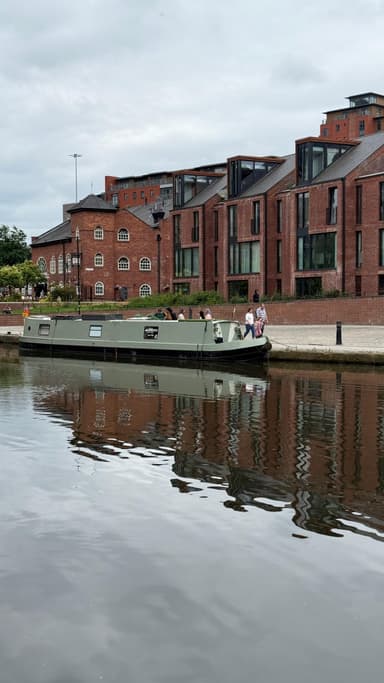
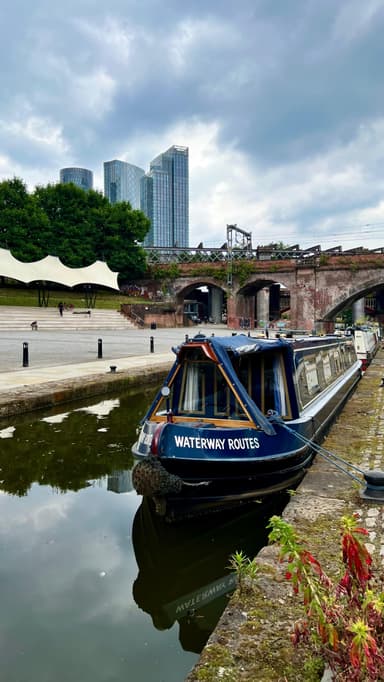
The trigger is political. Andy Burnham, until recently Mayor of Greater Manchester and now the frontrunner to lead the Labour Party — a role that would make him Prime Minister — has built much of his pitch around exactly that question. And, fittingly, he's been making the case from Manchester itself: the city of the worker bee.
From industrial emblem to sustainability icon
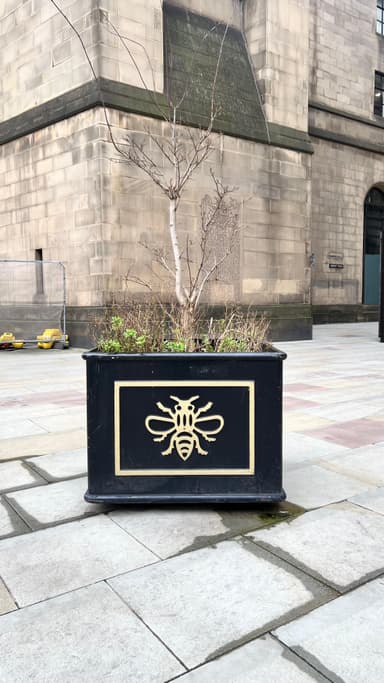
The Manchester worker bee dates back to the 19th century, adopted as a symbol of the city's work ethic at the height of the Industrial Revolution, when Manchester was the beating heart of Britain's textile trade. It sits on the city's coat of arms, hovering over a globe, and over time it's come to mean something broader: unity, resilience, collective effort.
That meaning was cemented in the aftermath of the 2017 Manchester Arena attack, when the bee spread spontaneously across the city as a mark of solidarity, long before any council campaign pushed it.
Today it's on murals, on tattoos, and on something rather more practical: the Bee Network, Greater Manchester's integrated public transport system — buses, trams and bikes — launched under Burnham's mayoralty and branded, appropriately, in black and yellow.
Burnham's pitch: growth "from the bottom up"
In a recent speech delivered in Manchester, the city where he spent nine years as mayor, Burnham set out his stall in one line: growth "cannot be ordered from the top down", he said. "It can only be nurtured from the bottom up."
His central pledge is devolution — handing more power and budget to local and regional government, on the basis that councils understand what their area needs, from fixing potholes to delivering major regeneration schemes, better than Whitehall does. It's the same model he applied in Greater Manchester when he built the Bee Network: a London-style integrated transport system that most of the country still can't replicate simply because they lack the local powers to do it.
What's that got to do with energy? Quite a lot, actually. Much of the infrastructure the energy transition depends on — district heating networks, EV charging points, home insulation schemes, community solar — gets decided and delivered locally, not nationally. If the next government genuinely backs a devolved model, that could mean real autonomy for cities like Manchester, Leeds or Bristol to build energy plans suited to their own industrial and social make-up, rather than waiting for one-size-fits-all guidance from London.
The energy challenges facing Britain
Symbolism aside, whoever ends up in Downing Street inherits a genuinely demanding energy agenda. Here are the biggest pressure points.
1. A grid that's outgrown its own capacity
Ofgem, Britain's energy regulator, has approved roughly £28 billion of investment to upgrade and expand the gas and electricity networks, with total committed spending potentially reaching £90 billion by 2031. The reasoning is straightforward: the current grid can't absorb all the renewable power — wind, in particular — now being generated, especially on windy, sunny weekends when supply outstrips demand in some regions and operators are forced to pay to switch generation off because the transmission network can't move it elsewhere.
It's an awkward trade-off. Upgrading the grid to make the most of clean power will, in the short term, push household bills up, even though the regulator itself expects the investment to start delivering net savings from 2031 onward, largely through reduced reliance on imported gas.
2. Import dependence and price volatility
Britain still relies on gas imports — liquefied natural gas in particular — to cover peak demand, leaving it exposed to volatile international markets and geopolitical shocks on the other side of the world. At the same time, the UK has become a net importer of electricity from continental Europe, where nuclear and renewable output tends to be steadier, reviving the debate over whether Britain should formally rejoin the EU's internal electricity market post-Brexit — a possibility Brussels has already floated opening talks on.
3. Fuel poverty and bills that won't come down
Energy costs remain one of the biggest concerns for British households. While the grid investment promises longer-term benefits, the immediate impact — an estimated £100-plus added to annual bills by 2031, split between gas and electricity — lands on families already worn down by years of high prices. Any government with serious sustainability ambitions will have to solve that tension first: how to decarbonise without leaving behind those who can least afford it.
4. Hitting net zero by 2050
The UK remains legally committed to net zero by 2050, with increasingly demanding interim targets for offshore wind, transport electrification and swapping gas boilers for heat pumps. The problem isn't really ambition — the legal framework already exists — it's delivery: planning permission that drags on for years, strained supply chains, and a reliance on private investment that only shows up when there's regulatory stability, something the revolving door at Number 10 hasn't exactly provided lately.
5. Balancing energy security and defence spending
There's also a less obvious but growing pressure: rising demands to increase defence spending amid a more volatile geopolitical picture, competing directly for the same fiscal headroom an accelerated energy transition would need. Whoever becomes the next Prime Minister will have to decide how to split a budget that simply doesn't stretch to cover everything.
So what does it all mean for sustainability?
This is where the bee earns its place in the story again. Its original meaning — collective effort, each bee doing its bit for a shared hive — maps almost too neatly onto the kind of energy transition many experts have been calling for in Britain for years: one where cities, regions and communities get real decision-making power, instead of depending entirely on national directives.
If the next government does back devolution, expect to see more community energy schemes, more local authority over decarbonising public transport — Manchester's already shown how with the Bee Network — and potentially faster, more responsive investment in local grid upgrades. The trade-off is coordination: the energy transition also needs planning at national scale — connecting offshore wind farms, interconnectors with Europe, national-level storage — that no single city can sort out on its own.
Whether that balance between local and national actually gets struck, or just stays campaign rhetoric, remains to be seen. But the fact that energy sustainability is now being debated in the language of devolution — not just emissions targets — is a genuine shift in framing, and one worth watching closely.
FAQs
Who is Andy Burnham? A British politician and former Mayor of Greater Manchester (2017–2026), now the frontrunner to lead the Labour Party following Keir Starmer's resignation — a role that would make him Prime Minister.
What does the Manchester worker bee symbolise? A 150-year-old emblem originally representing the city's industrious work ethic during the Industrial Revolution, now also standing for community and resilience, particularly since the 2017 Manchester Arena attack.
What are the UK's biggest energy challenges right now? Upgrading an overstretched national grid, reducing reliance on gas imports, tackling fuel poverty, hitting net zero by 2050, and competing budget pressure from rising defence spending.
Want to understand how these shifts in UK energy policy could affect your bills or your renewable options? At EnergieBee, we track every move in the sector so you can make better energy decisions.
 David Price
 Danie Latorre